
Find an idea worth taking to the next step
Choosing a niche sounds simple.
Pick something you like. Make a website. Recommend a few products. Wait for the money to come rolling in.
That would be nice.
The truth is that some interesting subjects make poor businesses. People may enjoy talking about them but never buy anything. There may be plenty of products but almost no one searching for them. Or there may be so many large companies fighting over the market that a beginner has very little room to breathe.
The opposite is also true.
A niche that sounds boring, strange or much too specific may have active buyers, useful products and questions no one is answering particularly well.
That is what we are looking for here.
Not the perfect niche. I am not sure there is such a thing. We are looking for a promising niche worth testing.
Enthusiasm helps. It is easier to work on something you find interesting. But enthusiasm cannot make people search, buy products or join a service. We need a little evidence to go along with it.
By the end of this tutorial, you should have one niche that looks strong enough to carry into Stage 2.
It is a starting point.
You are not marrying it. You do not have to get its name tattooed on your arm. You are simply choosing the best opportunity you have found so far.
Stage 2 is where we find out whether that provisional niche actually deserves to become our niche.
For now, our job is simpler:
Find a market that shows signs of life, has a possible path to income and interests you enough to keep going.
Tutorial index
This tutorial may take more than one sitting.
You might open a worksheet, do a little searching, get distracted, eat lunch, go to work, sleep for eight hours—or forget about it for three days.
That is fine.
The worksheet links will open in a new tab. Download or print the worksheet there, then return to this page when you are ready to continue.
Use the index to come back to the place where you left off.
- What are we looking for?
- The 50 → 10 → 3 → 1 process
- Choose how you want to use this tutorial
- A quick word about AI
- Set up the Atlas Niche Companion—optional
- Worksheet 1: Build your big idea list
- Worksheet 2: Gather real evidence
- Worksheet 3, Part 1: Choose the finalists
- Worksheet 3, Part 2: Take a closer look
- Final Business Check
- Review and save your Stage 1 project
- Continue to Stage 2
Use the small Back to tutorial index link at the end of each main section whenever you need it.
What are we looking for?
A niche is a smaller part of a larger market.
Pets is a market.
It includes dogs, cats, birds, fish, snakes, hamsters, rabbits and probably several animals I would not want loose in my house.
It is much too broad for what we are doing.
Cat products is narrower, but it still includes food, litter, grooming, beds, toys, medicine, scratching posts and those little costumes cats always look so happy to be wearing.
Indoor cat enrichment is narrower again.
Now we are looking at toys, climbing spaces, puzzle feeders, scratching surfaces and other ways to keep indoor cats active and interested.
Indoor enrichment for older cats is more focused.
Older cats may move less, become bored, gain weight or lose interest in toys made for younger cats. Their owners may be looking for gentler ways to keep them active and mentally engaged.
There may be puzzle feeders, slow-moving toys, ramps, steps, perches and other products connected to those needs.
Now we have something we can investigate.
It sounds possible.
Possible is not the same as proven. That is why we are doing the research.
When I look at a niche, I ask four basic questions.
Are real people interested?
People should be doing something around the subject.
They may be searching Google, watching videos, asking questions, comparing products, reading reviews or spending money.
We are not looking for a magical number that guarantees success. No such number exists, though I am sure someone online will be happy to sell you one.
We are looking for activity.
Does the market appear alive?
Later, we will look at Google Search, Google Trends, marketplaces and keyword tools. Each one gives us a different piece of the picture.
None of them knows everything.
Put together, they can tell us quite a bit.
Is there a place for us?
Beginners are often told to find a market with high demand and low competition.
Wonderful idea.
While we are at it, perhaps we can find a suitcase full of money with no owner.
Competition is not always the enemy. It can show us that people care about the subject, products are selling and businesses are willing to spend money reaching the audience.
The real problem is finding a place to begin.
If every useful search result is controlled by Amazon, government websites, enormous publishers and companies with several hundred employees, we may have a difficult time getting noticed.
But even a crowded market can have smaller openings.
Large websites often write for everyone. That can leave smaller openings for us. A major home-appliance site may cover refrigerators, washing machines, ovens and every other machine with a plug. We might focus instead on compact electric kitchen appliances for people living in small apartments. The market is smaller, but the audience and its needs are much clearer.
We may be able to help a particular group, answer a more specific question or explain something the larger sites have rushed through.
So the question is not:
Is there competition?
The question is:
Is there some useful corner of this market where I may realistically be able to help?
Is there some way to earn money?
This is an affiliate-marketing route.
We are here to build something useful, but we are also here to make money. There is nothing wrong with saying that out loud.
A niche needs products or services that solve real problems for the people in the market.
Those might be physical products, digital products, software, subscriptions, services, memberships or courses.
We are not going to investigate every affiliate program and commission rate during Stage 1. We only need enough evidence to choose a niche worth testing. Stage 2 will look much harder at what people can buy, how we might get paid and how crowded the market looks.
For now, we only need to see that useful products exist and that there appears to be some reasonable way to earn from recommending them.
If we cannot find anything useful to recommend, that is worth knowing before we spend six months building a website.
Are you willing to keep going?
You do not have to be passionate about your niche.
Passion is nice. It is also a bit unreliable.
I have been passionate about things on Monday that I wanted nothing to do with by Friday.
What matters is whether you are willing to keep learning after the excitement wears off.
Can you imagine reading about the subject, looking at products, answering questions and creating useful material for the next six months?
Perhaps you already know the market.
Perhaps you know almost nothing about it but find yourself becoming curious.
Both can work.
The best niche will usually have some balance between four things:
Interest in the market, a realistic place to begin, a possible way to earn and your willingness to continue.
We are unlikely to find a niche that is perfect in all four areas.
That is all right. We are not trying to win a perfection contest. We are trying to make a sensible choice and move forward.
Visual summary:
Interest · Opportunity · Income · Willingness
The 50 → 10 → 3 → 1 process
Trying to choose one niche from everything on the internet is a very large problem.
I prefer smaller problems.
We are going to use a funnel.
We will begin with a broad collection of ideas, gather a little evidence, narrow the list and then take a closer look at the strongest choices.
The numbers are useful targets. They are not rules.
Worksheet 1: Build your list
We will begin with roughly 25 to 50 ideas.
That may sound like a lot. It is a lot if you sit in front of a blank sheet of paper and try to force 50 brilliant niche ideas out of your head.
That is not what we are going to do.
You can write down a few ideas, search one of them, notice a related product, add another idea and continue from there.
One idea may lead to five more.
You may start with ten and return tomorrow. You may reach 75 and have to tell yourself to stop.
The purpose of Worksheet 1 is to create possibilities and get comfortable looking at markets.
We are not narrowing yet. We are giving ourselves something to work with.
Worksheet 2: Look for real activity
Next, we will use Google Search, Google Trends and Amazon—or another marketplace that fits the idea.
These are simple checks.
Are people searching? Has interest held up over time? Are products available? Do customers appear to be buying them?
This is where some ideas will start to look stronger and others will begin quietly backing toward the door.
By the end, we should have somewhere around five to ten possibilities worth carrying forward.
Worksheet 3, Part 1: Choose the finalists
Semrush is an online research tool that helps us see what people type into Google, roughly how often they search for it and how difficult that search may be to compete for.
It can show us far more than that.
For now, those are the pieces we need.
We will use them to compare the five to ten remaining niches and find the two or three that give us the best places to begin.
Worksheet 3, Part 2: Take a closer look
The final two or three deserve more attention.
We will look at several search phrases around each niche instead of judging the whole market by one phrase.
That will show us whether people are asking useful questions, comparing products and searching in ways that could later become articles, guides and recommendations.
Final Business Check
The strongest one or two niches will receive one last practical check.
We will name useful products or services, look for possible affiliate programs, make sure there is enough useful content to create and describe the people the niche may help.
Then we choose one provisional niche and move on.
Could another niche have worked?
Probably.
Could we discover something later that changes our mind?
Certainly.
That does not mean the process failed. It means we learned something.
For now, we choose the strongest possibility we have found and take it into:
Stage 2: Research Your Market
That is where the provisional niche has to prove itself. We’ll look at what people can buy, how affiliate programs pay and what the competition looks like, then decide whether to keep it or go back and choose another.
Visual summary:
25–50 possibilities → 5–10 stronger ideas → 2–3 finalists → 1 niche to test
Choose how you want to use this tutorial
You can read through the tutorial first and follow our worked example before using your own ideas.
Or you can use the printable worksheets and follow along with your own niche ideas as you move through the tutorial.
Or you can use the Atlas Niche Companion in ChatGPT and follow along with your own ideas while AI helps you organize the research and decisions.
You can use one approach or mix them as you go. The goal is to help you find a good niche—one you can realistically enter, serve well and monetize.
A quick word about AI
You may be wondering why you need to learn any of this.
Why not open an AI and type:
Give me a profitable affiliate niche with high demand, low competition and lots of products.
You can.
You will get an answer.
You may get 20 answers before your coffee cools down. They may look organized, intelligent and extremely convincing.
Some may even be good.
AI is amazing. I am using it right now to help build Open the Atlas. It helps with research, design, writing, coding, planning and a pile of other work that would normally require several people and more money than I currently feel like spending.
It is like having a team of researchers, designers, writers and assistants waiting around for something to do.
Unfortunately, sometimes the team gets confused.
AI may miss an important part of the market. It may rely on old information, misunderstand a question, overlook a weak assumption or confidently tell you about an affiliate program that disappeared two years ago.
It may also wander away from the job you gave it and start solving a different problem entirely.
I have some experience with that.
I did most of my studying before AI became widely available. I took courses, subscribed to services, tried different platforms, bought hosting, read a great deal, tested things and generally screwed up often enough to learn a few lessons.
That knowledge is what helps me guide the AI now.
I know enough to ask why it reached a conclusion. I can see when it skipped something. I can tell it to check again, use a better source or go back to the point where it wandered off into the bushes.
If I knew nothing about the process, I would have no idea when it was wrong.
That is the point.
Learning the path is not something you do because AI cannot help. You learn the path so AI can help you properly.
Once you understand what should be checked, AI can make the work much faster. It can help generate ideas, organize the research, compare results, keep notes and point out things you may have missed.
But it still needs someone steering.
That someone is you.
The free Atlas Niche Companion can work beside you while you move through Stage 1.
It will not press a button and reveal your one true niche.
I wish it could.
What it can do is help you follow the process without losing track of what you found or why you made a decision.
That is a much more useful trick.
Set up the Atlas Niche Companion—optional
You do not need the Companion to complete Stage 1.
To use it, open the Companion request form in a new tab. Enter your email and we will send you the download link. You can then type what you found, paste notes or upload a clear screenshot when that is easier.
Get the Atlas Niche Companion Kit by email
The kit is a ZIP file. After it arrives, download and extract it. Then open the included setup guide first: START_HERE_Atlas_Niche_Companion_Setup_Guide.pdf.
The visual guide walks through the setup one step at a time. Keep this tutorial open in one browser tab and ChatGPT open in another while you follow it.
Worksheet 1: Build Your Big Idea List
Now we need some ideas.
Not one brilliant idea. Not the idea that will make you rich while you sleep. We are looking for a broad collection of possibilities that gives us something useful to investigate.
Open Worksheet 1: The Big Idea List in a new tab
The worksheet has four simple columns:
| Niche idea | Quick Market Signal | Yes / Maybe / No | Notes |
|---|
You can move through it in whatever way feels natural.
You may write down several ideas before searching any of them. You may search one idea, discover three related products and add three more ideas. You may fill half the page today and return tomorrow.
All of that works.
Twenty-five to fifty ideas gives us a useful range, but the number is a target rather than a rule. Ten ideas are better than staring at an empty page because 50 sounded exhausting.
Once you begin searching, the list may grow faster than you expect.
Where can the ideas come from?
Start with what you already know, notice or find interesting.
Your first ideas may come from:
- hobbies or interests
- work experience and useful skills
- products you have bought or spent time researching
- problems you have solved
- groups of people or ways of living you understand
- strange products or subjects that make you curious
The first few will probably be obvious.
If you enjoy gardening, you may write gardening. If you have spent years teaching, you may write educational products. If you recently spent two weeks trying to find a quiet blender that would not frighten the neighbors, write that down too.
These ideas do not need to be polished.
A broad idea can lead to something much more useful.
For example:
Gardening might lead to:
balcony gardening
indoor herbs for beginners
raised gardens for older adults
gardening tools for people with limited hand strength
Kitchen appliances might lead to:
compact appliances for small kitchens
quiet appliances for apartments
countertop cooking for people without a full kitchen
One idea often leads to another. Follow it.
Add an idea and take a quick look
When an idea catches your attention, add it to the Niche idea column.
Then give it a simple Google search.
You are not doing serious research yet. You are taking a quick look around to see whether the market appears alive.
Let’s use our example:
indoor enrichment for older cats
Search that phrase in Google and look at the first page as a whole.
You may see products, stores, articles, videos, advertisements, related questions or other suggested searches.
Each of those tells us something.
Products and stores show that companies are serving the market. Articles and videos show that people are creating and consuming information around it. Related questions may reveal what people want help with.
You are looking at the overall picture rather than counting every result.
A two- or three-minute look is usually enough to form a first impression. You may also find better wording or another niche idea while you search.
That is part of the exercise.
Give it a Quick Market Signal
After the search, add one of three ratings to the Quick Market Signal column.
Strong
The results show clear signs of an active market.
You may see several products, stores, articles, videos, advertisements or reviews connected to the idea.
Strong does not mean guaranteed.
It means there appears to be enough going on to make the idea worth another look.
Average
There are some signs of activity, but the market is less obvious.
You may find a few products, mixed search results or a smaller amount of useful information.
Average is not bad. Some good opportunities take a little more work to see clearly.
Weak
The search gives you very little to work with.
Perhaps there are few useful products, hardly any current information or results that have almost nothing to do with the idea.
Weak is a first impression, not a death sentence. Another phrase may show more. For now, it simply tells us that other ideas may deserve attention first.
Strong, Average and Weak are quick market signals. They are not final judgments.
Mark Yes, Maybe or No
Now decide how you feel about investigating the idea further.
This column is about your willingness, not whether the niche has been proven profitable.
Yes
You are willing to learn more.
Perhaps you already know something about the subject. Perhaps it simply caught your attention.
Maybe
You are unsure, but you are open to seeing where it goes.
Some of the better ideas on your list may be markets you know almost nothing about today.
No
You would rather spend your time somewhere else.
You may dislike the subject, feel no curiosity about it or have no desire to spend the next several months reading about it.
That is useful information too.
Keep the full list together. The No ideas may help you remember what you considered, and sometimes one of them leads to a better idea later.
Use the Notes column when something stands out
The Notes column is optional.
A few words are enough:
lots of products
many videos
seems broad
mostly medical information
unfamiliar but interesting
several stores
results look limited
The note is there to help your future self remember what you saw.
Your future self may need the help.
Mine often does.
What this might look like
| Niche idea | Quick Market Signal | Yes / Maybe / No | Notes |
|---|---|---|---|
| Indoor enrichment for older cats | Strong | Yes | Products, guides and videos |
| Small-apartment gardening | Strong | Yes | Many products and tutorials |
| Vintage typewriter ribbons | Average | Maybe | Products exist; market looks small |
| Universal remote controls | Strong | Maybe | Active product market |
| Left-handed underwater knitting tools | Weak | No | Very little to work with |
The last idea is ridiculous.
Ridiculous ideas are allowed. Occasionally, they lead somewhere useful. A search for an odd product may introduce you to a larger market, a related problem or an audience you had never considered.
That is one reason we are starting wide.
Let the search help build the list
You do not need to separate brainstorming from searching.
The process may look more like this:
idea → quick search → related product → new idea → short note → another search
Suppose you begin with cat toys.
The search results may introduce you to:
cat puzzle feeders
toys for cats left alone during the day
climbing products for small apartments
toys for anxious cats
indoor enrichment for older cats
One broad idea has now given you five more specific possibilities.
This is often easier—and a great deal more interesting—than sitting in front of a blank worksheet trying to think of 50 unrelated niches.
When is Worksheet 1 finished?
There is no magic finishing number.
You are ready to continue when you have a broad collection of ideas and enough Yes and Maybe choices to investigate.
Twenty-five to fifty ideas is a good target. Some people will have fewer. Some will have far more.
Mark every idea Yes, Maybe or No.
If more than 25 ideas have a No beside them, add a few more possibilities. We want enough unresearched choices left on the page to make Worksheet 2 worthwhile.
There is no need to narrow the list yet.
Worksheet 1 gives us possibilities.
Worksheet 2 will help us see which ones have real evidence behind them.
Continue to Worksheet 2: Gather Real Evidence
Worksheet 2: Gather Real Evidence
Worksheet 1 gave us a pile of ideas.
Some looked promising. Some looked strange. A few may have been added because 50 is a large number and panic had begun to set in.
That is all fine.
Now we are going to take the ideas marked Yes or Maybe and see whether they continue to look interesting after we poke them a little harder.
Worksheet 1 asked:
Does this market appear to be alive?
Worksheet 2 asks:
Does it keep looking alive when we check it in a few different ways?
Open Worksheet 2: Gather Real Evidence in a new tab
The worksheet has six columns:
| Niche idea | Google search activity | Trend pattern | Product activity | Overall signal | Notes |
|---|
I will keep using indoor enrichment for older cats so we can watch one idea move through the process.
You can work on one of your own ideas beside it, or read through the example first and return to the worksheet afterward.
Both work.
Ask Google a few better questions
In Worksheet 1, we gave the idea a quick glance.
Now we want to see whether it keeps leading us back to the same market when we try a few sensible searches.
For our example, we could use:
indoor enrichment for older cats
senior cat toys
how to keep an older cat active
Think of it as poking the idea from three different sides.
The first search uses the name we gave the niche.
The second looks for something a person might buy.
The third looks for a problem someone may be trying to solve.
If all three searches keep leading us back to older cats, boredom, activity, mobility and suitable products, we may have something.
Are similar questions turning up? Are there recent articles, videos, stores and products serving the same general market?
Or did Google have to rummage through the attic to find anything at all?
Screenshot 1: A product search
Use:
senior cat toys
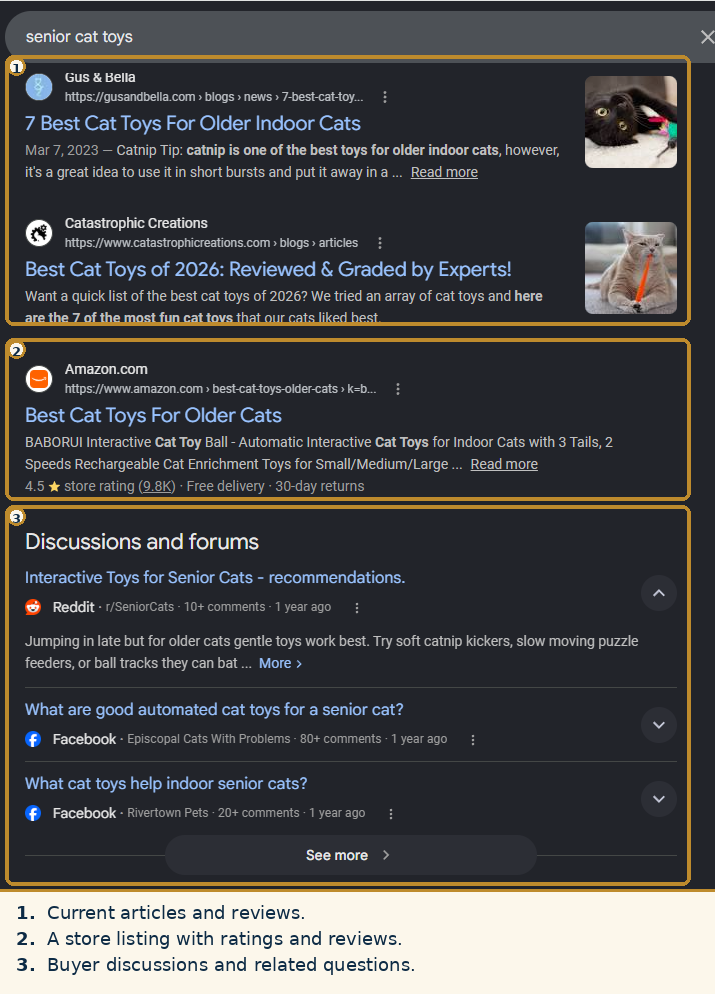
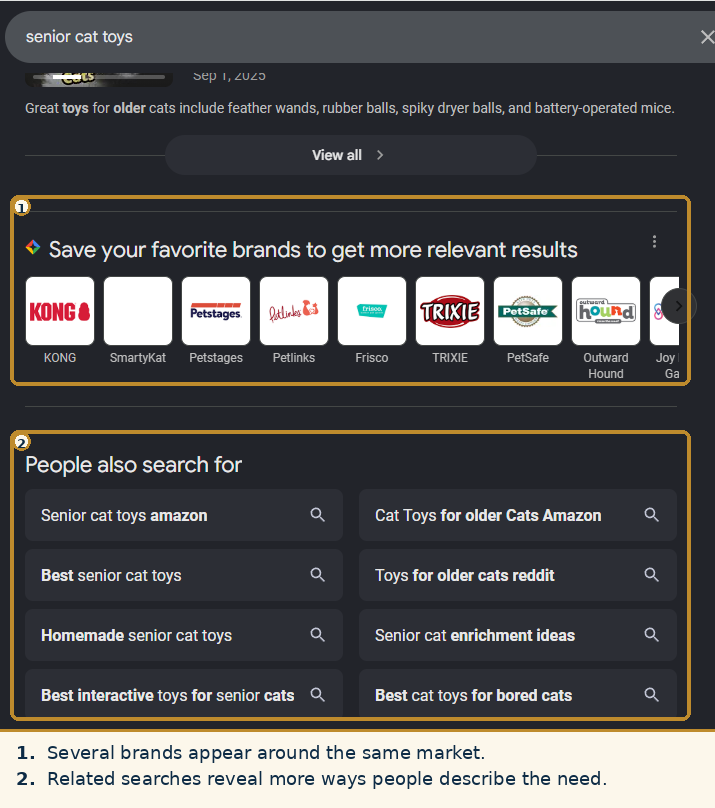
One result would not tell us much. This page gives us product reviews, a store listing, buyer discussions, brands and several related searches.
Screenshot 2: A problem search
Use:
how to keep an older cat active
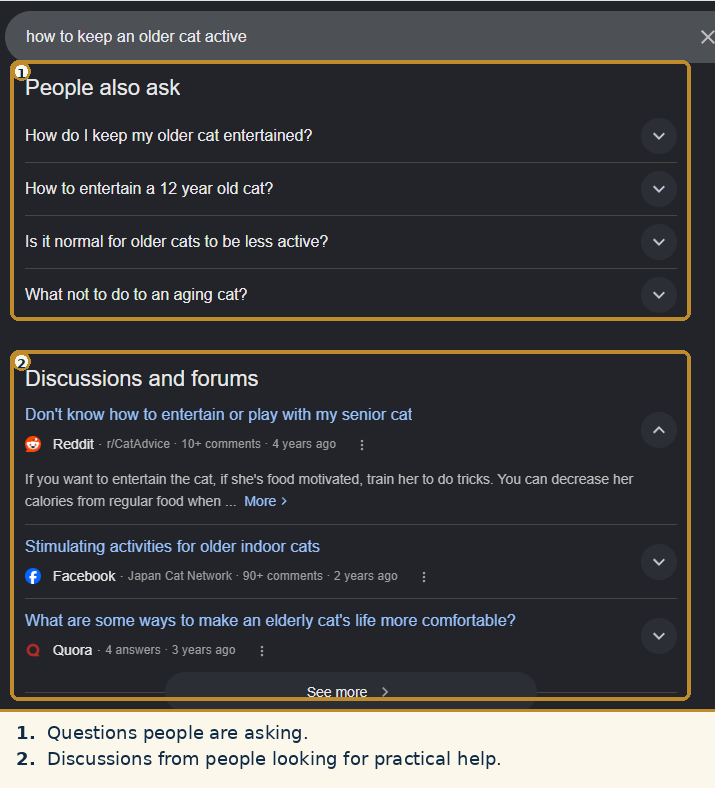
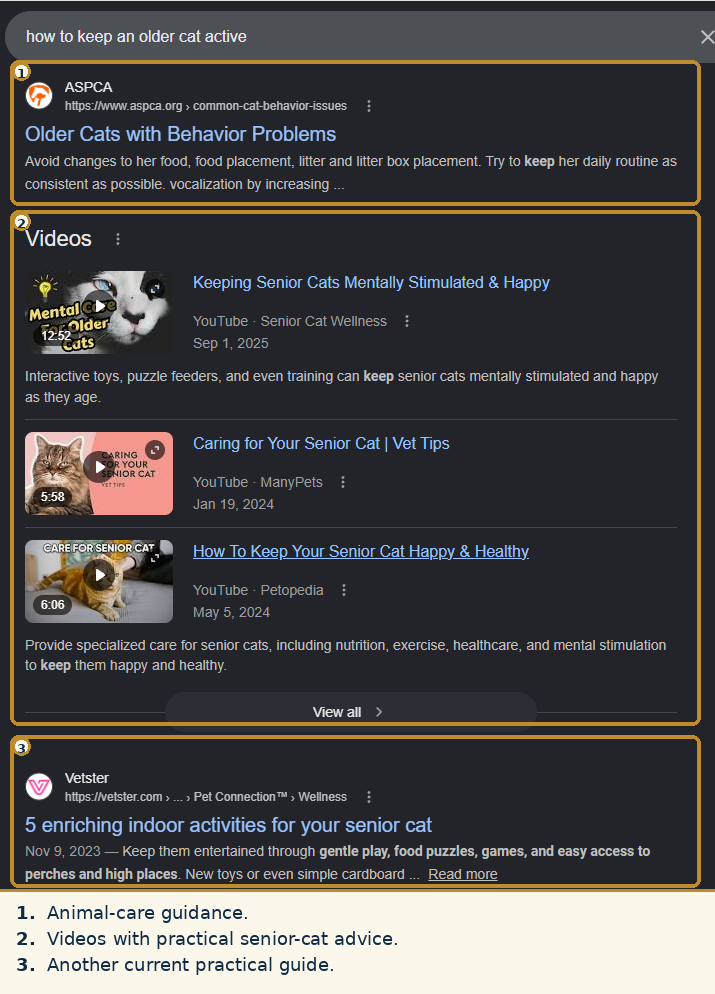
This search gives us questions, discussions, animal-care guidance, videos and practical articles. People are not only looking for products. They are looking for help.
Several sensible searches pointing toward the same market are more useful than one busy results page.
Rate the Google search activity
Add one rating to the Google search activity column.
Strong means several searches lead to useful, current results connected to the same market.
Average means some useful patterns appear, but the picture is still mixed.
Weak means the searches give us very little consistent activity around the idea.
Our first row might look like this:
| Niche idea | Google search activity | Trend pattern | Product activity | Overall signal | Notes |
|---|---|---|---|---|---|
| Indoor enrichment for older cats | Strong | Products and questions appeared across several searches |
The Notes column can hold anything worth remembering:
better results with “senior cat toys”
several current guides
searches led in different directions
mostly unrelated results
A few words will do.
See whether the interest has lasted
Google Search showed us what is appearing today.
Google Trends lets us step back and see what has been happening over time.
Open Google Trends in a new tab
Choose the country where most of the people you hope to reach live. Then use a longer time range, such as the past five years, so one unusual week does not control the picture.
Begin with the name we gave the niche:
indoor enrichment for older cats
Enter it and see what happens.
There may not be much of a graph.
That is not exactly the welcome we were hoping for, but it does not mean we should throw the niche away.
The phrase makes sense to us because we have spent time thinking about the market. A cat owner may use much simpler words.
Screenshot 1: The exact niche phrase
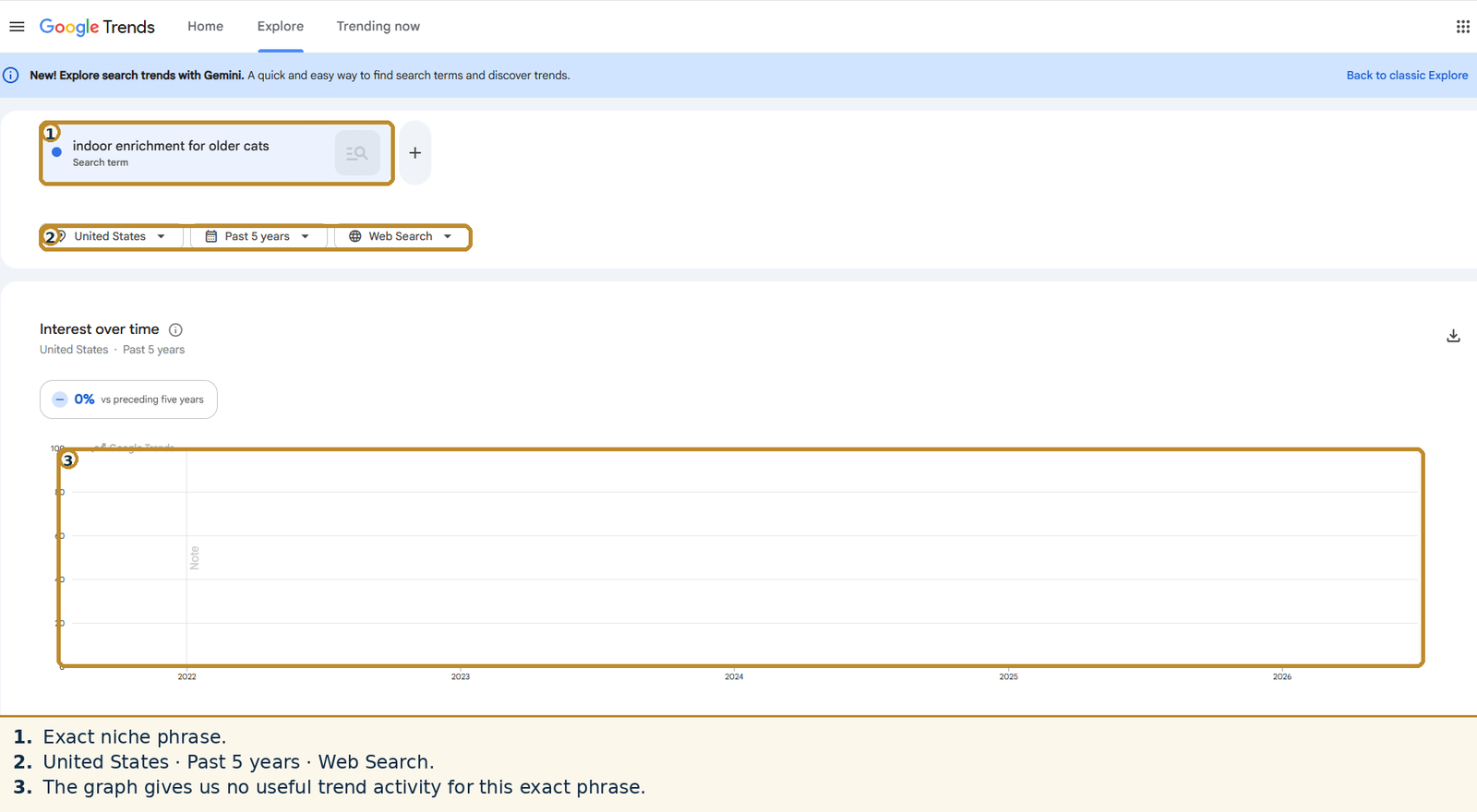
A useful niche description is not always a phrase people type into Google. This one does not give us enough activity for a useful graph.
Now try something broader:
indoor cat enrichment
This still belongs to the same market, but it gives Google more room to work with.
Screenshot 2: The broader phrase
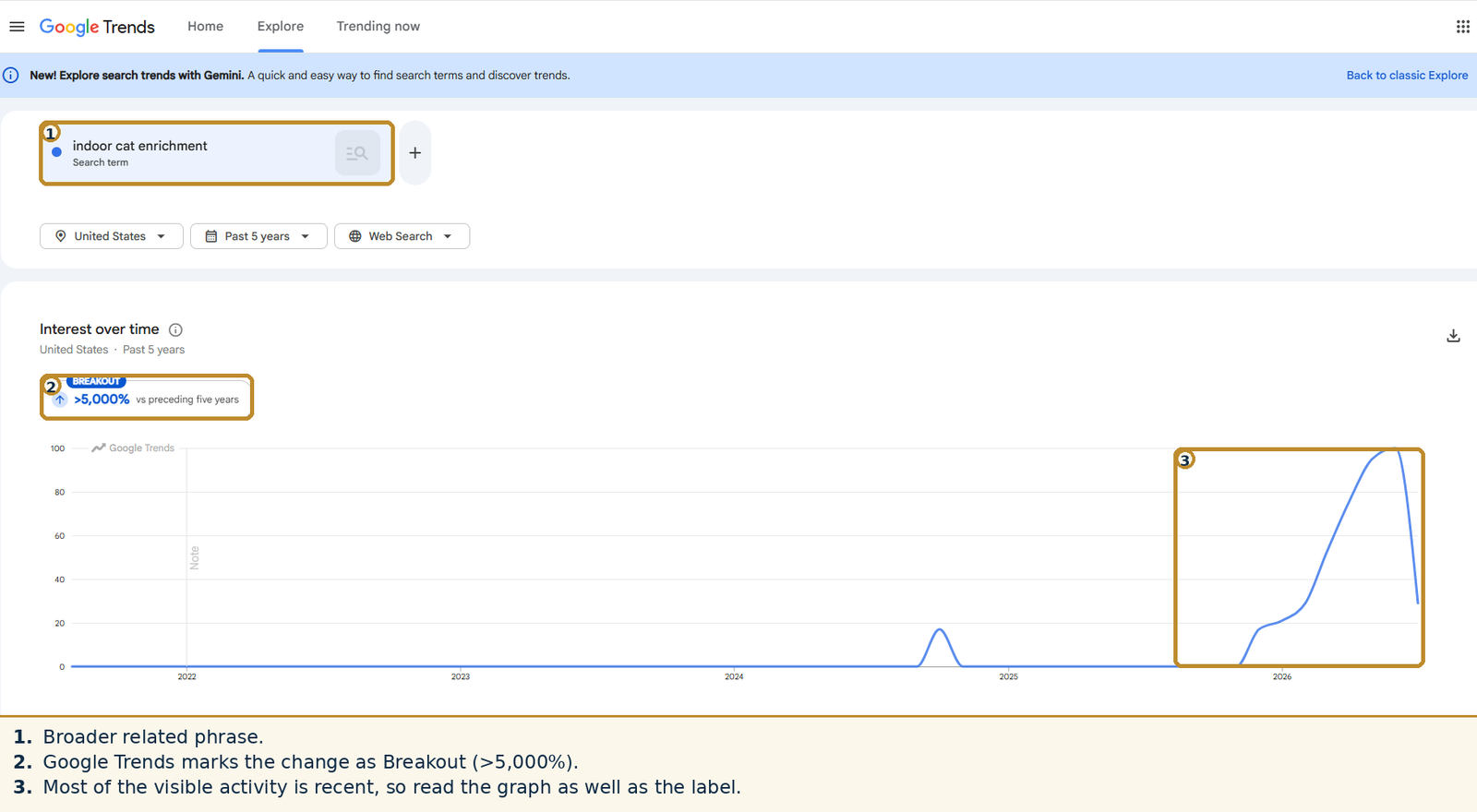
The broader phrase gives us a useful graph. Interest is growing, but most of the visible activity is recent.
Google Trends labels this change Breakout and shows growth of more than 5,000% compared with the preceding five years.
That is encouraging.
It is also a reminder to read the graph rather than the label alone. This is a recent rise, not five years of steady interest.
Write the phrase and that detail in the Notes column:
Trends phrase: indoor cat enrichment; recent breakout
Google Trends does not give us an exact monthly search count here. It shows relative interest. The highest point on the graph is marked 100, and the other points are measured against it. Read how Google Trends data works.
We do not need to explain every rise and fall.
We want the general shape.
If interest has been moving upward, mark it Growing.
If it has stayed fairly consistent, mark it Steady.
If the same peaks return at similar times each year, mark it Seasonal.
If interest appears to be falling over the longer period, mark it Declining.
If the graph gives us very little to work with, mark it Unclear.
Steady is not boring. A market does not need fireworks. It needs people who continue to care.
Seasonal is not bad either. Christmas decorations, gardening tools and pool supplies all have times when the buyers arrive in force and times when they apparently have other things to do.
Declining interest does not automatically rule out the niche, but it gives us a reason to find out what may be changing.
What does a seasonal pattern look like?
Use a familiar search such as:
Christmas decorations
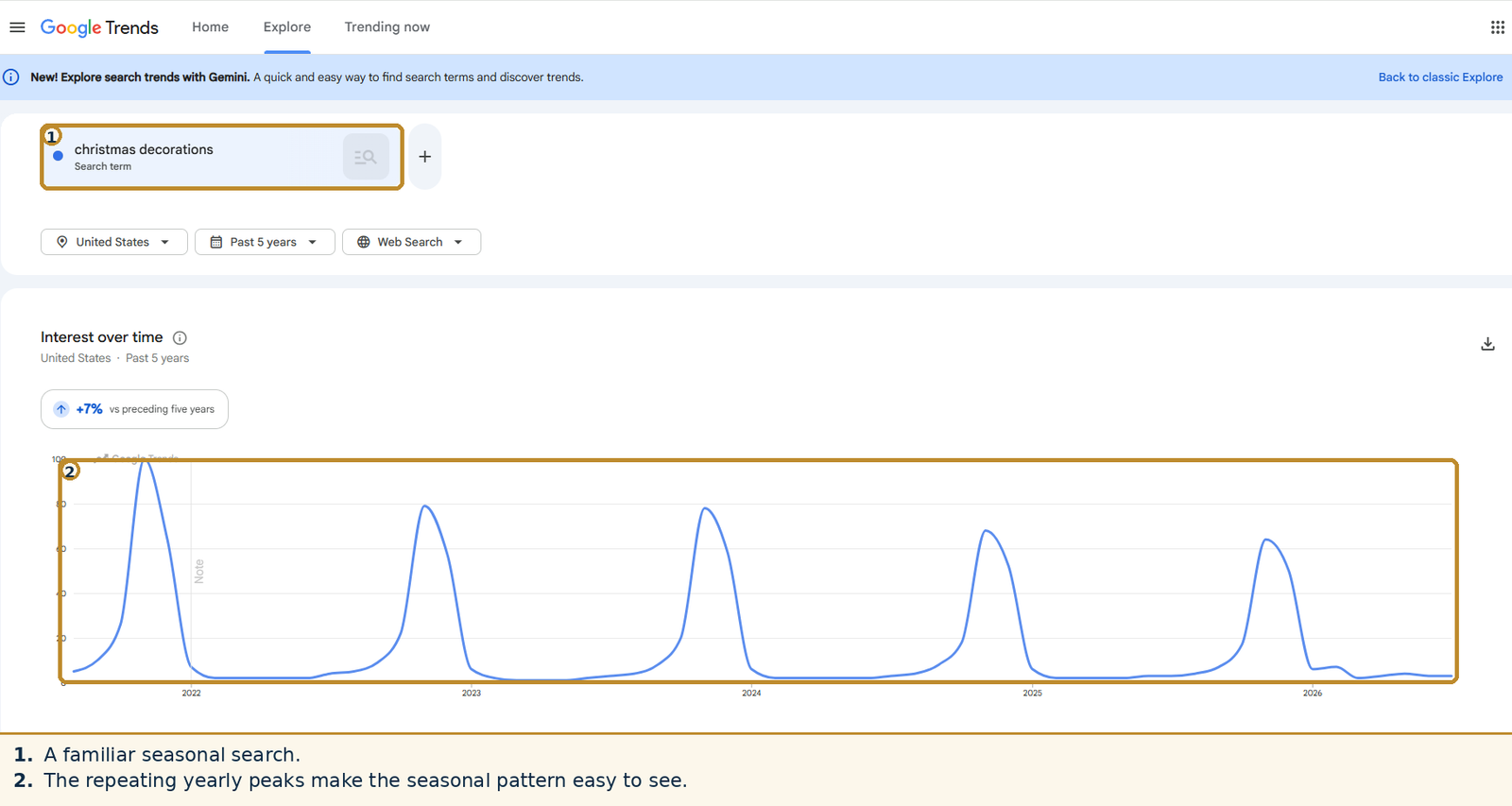
Some markets wake up at the same time every year. They can still make money, but the calendar matters.
Now add the pattern to the worksheet.
| Niche idea | Google search activity | Trend pattern | Product activity | Overall signal | Notes |
|---|---|---|---|---|---|
| Indoor enrichment for older cats | Strong | Growing | Trends phrase: indoor cat enrichment; recent breakout |
Go where people are spending money
Now we want to see what people can actually buy.
For a physical-product niche, Amazon is an obvious place to begin.
[Open Amazon in a new tab]
For our example, try:
senior cat toys
or:
interactive toys for older cats
Look across the page.
We are hoping to find more than one lucky product.
One bestseller is nice. It is not an entire market. It may simply be one clever toy with a good photograph and 14,000 reviews from people whose cats ignored it.
A stronger market gives us several types of products.
For older-cat enrichment, we may find puzzle feeders, slower interactive toys, scratching products, ramps, steps, tunnels, perches and comfort products.
That is encouraging because it gives us several ways to help the same general audience.
Look at the sellers and brands too.
Are several companies offering related products, or is one company doing everything? Do the listings have ratings and written reviews? Are some of those reviews recent?
Recent activity tells us more than a product page that has been gathering dust since 2017.
Prices matter as well.
A market with inexpensive products, mid-priced choices, premium items and accessories gives us more to work with than a market built around one five-dollar object people replace every twelve years.
We are not trying to calculate future earnings today.
We are asking a simpler question:
Does this look like a real group of products being sold to real customers?
Amazon will not fit everything
Amazon is useful, but it is not the answer to every question ever asked.
Etsy may be better for handmade goods, craft supplies, personalized products or printables.
eBay may tell us more about collectibles, replacement parts, used products and older items.
Some niches have specialist stores that give us a much clearer look at the serious market.
If you are researching professional diving equipment, a proper diving retailer will probably tell you more than three pages of inflatable pool toys on Amazon.
Use the place that fits the idea.
Rate the product activity
Mark the Product activity Strong when several relevant product or service types appear and customer activity is visible across more than one listing or provider.
Mark it Average when useful products or services exist but the range or activity looks limited.
Mark it Weak when there are very few useful choices or hardly any evidence that people are buying them.
Our worksheet may now look like this:
| Niche idea | Google search activity | Trend pattern | Product activity | Overall signal | Notes |
|---|---|---|---|---|---|
| Indoor enrichment for older cats | Strong | Growing | Strong | Recent breakout; several product types, ratings, reviews and recent purchases |
Marketplace results
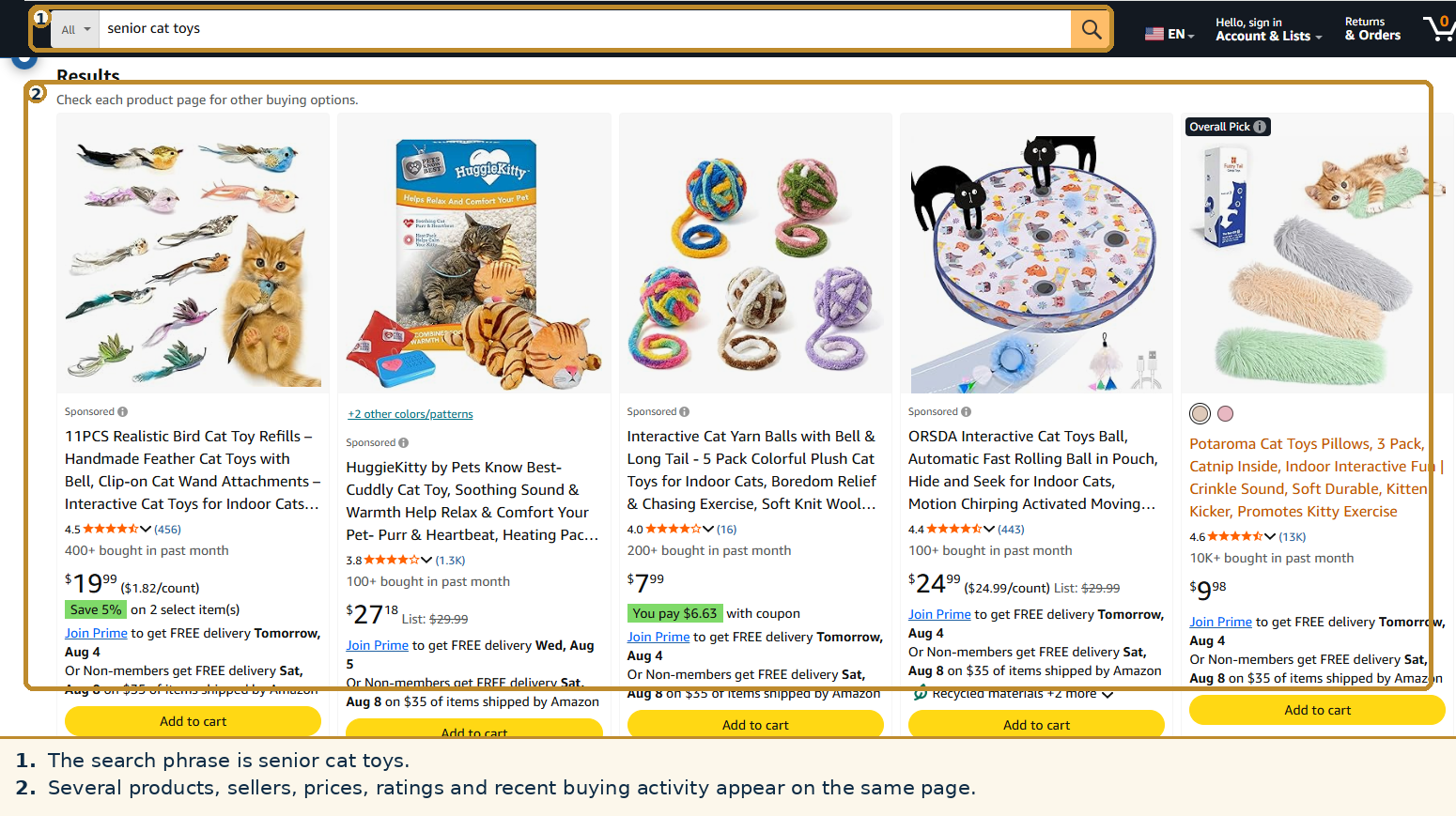
One popular item is interesting. Several product types, prices, brands, ratings, reviews and recent purchases begin to look like a market.
Work through the rest of your ideas
Take the next idea you marked Yes or Maybe on Worksheet 1 and give it the same checks.
For each niche, look at:
a few sensible Google searches
the pattern in Google Trends
the products or services people can buy
Leave the Overall signal column blank until the other rows are finished.
Some ideas may need better wording or a different marketplace. Others may lead to a related niche that looks more useful than the one you started with.
Add new ideas when they appear.
You may also discover that an idea you liked has very little market behind it.
That is useful.
Finding out now can save you months of work later.
Compare the completed rows
Once the Search, Trend and Product columns are filled in, look across the whole table.
This is why we left the last column alone.
A niche can look impressive when it is sitting by itself. Put it beside the others and the picture may change.
One idea may have plenty of search activity but very few useful products. Another may show steady interest, several product types and searches that keep leading back to the same market.
Now give each idea an Overall signal.
Promising
The evidence looks encouraging and the niche deserves to continue.
Uncertain
The evidence is mixed, or there is still something important we need to understand.
Weak
The stronger ideas on the worksheet give us more to work with.
The Overall signal is not a mathematical average.
It is your summary of what you found.
The worksheet is supposed to help your thinking. Your thinking does not have to obey the worksheet.
Build your stronger shortlist
Look down the Overall signal column.
The Promising ideas will usually be the easiest ones to carry forward.
An Uncertain idea can come too if it still interests you, has one particularly good signal or seems close to becoming Promising with better wording.
Somewhere around five to ten ideas gives us a useful shortlist for Worksheet 3.
You may end up with four.
You may end up with eleven.
No one from the Department of Niche Selection is going to arrive at your door.
What matters is that the new list is stronger than the old one.
Worksheet 1 gave us possibilities.
Worksheet 2 gave us evidence.
Worksheet 3 will help us compare the strongest ideas and bring the list down to two or three finalists.
Continue to Worksheet 3, Part 1: Choose the Finalists
Worksheet 3, Part 1: Choose the Finalists
Worksheet 2 should have left us with somewhere around five to ten stronger ideas.
We have seen search activity, interest over time and products or services people can buy.
That was enough to keep the ideas.
Now we need to know which ones give us the best places to begin.
Semrush will help us compare one useful search phrase for each niche.
It will give us several numbers. We are only looking at two of them for now:
roughly how often people search for the phrase
how difficult it may be for a new website to get noticed
We will also save a few other useful phrases for Part 2.
Open Worksheet 3: Compare and Choose in a new tab
The first table looks like this:
| Niche idea | Phrase to compare | Monthly searches | Difficulty | Other useful phrases | Decision |
|---|
I will keep using indoor enrichment for older cats.
You can enter one of your own niches and work beside the example, or follow the older-cat row first and complete yours afterward.
Begin with a seed keyword
In Worksheet 2, we saw that the name we give a niche and the words people type into Google are not always the same.
For the older-cat example, one of the useful searches was:
senior cat toys
That gives us a sensible place to begin.
Semrush calls the first phrase we enter the seed keyword. It is simply the starting point the tool uses to find related keywords.
Put the niche in the first column. Leave Phrase to compare blank for the moment.
| Niche idea | Phrase to compare | Monthly searches | Difficulty | Other useful phrases | Decision |
|---|---|---|---|---|---|
| Indoor enrichment for older cats |
The seed keyword starts the search.
The Phrase to compare is the keyword we eventually choose for the worksheet.
They may turn out to be the same phrase.
They do not have to be.
Open the Keyword Magic Tool
Create a free Semrush account and open the Keyword Magic Tool in a new tab
Create an account using one of the signup options Semrush gives you.
You do not need payment information for the free account.
Semrush does not make the free route especially obvious.
After the signup questions, it may show you a subscription offer with a large Start your free trial button and a much quieter Don’t start free trial option.
For this tutorial, choose Don’t start free trial.
You do not need the trial for this exercise. Start it only when you deliberately want to test the paid plan. Semrush says the selected paid plan begins automatically when the trial ends unless you cancel beforehand. Read Semrush’s trial and subscription information.
If Semrush opens on its SEO dashboard, ignore the large domain box and the Start free trial button at the top.
In the menu on the left, find Keyword Research, then click Keyword Magic Tool.
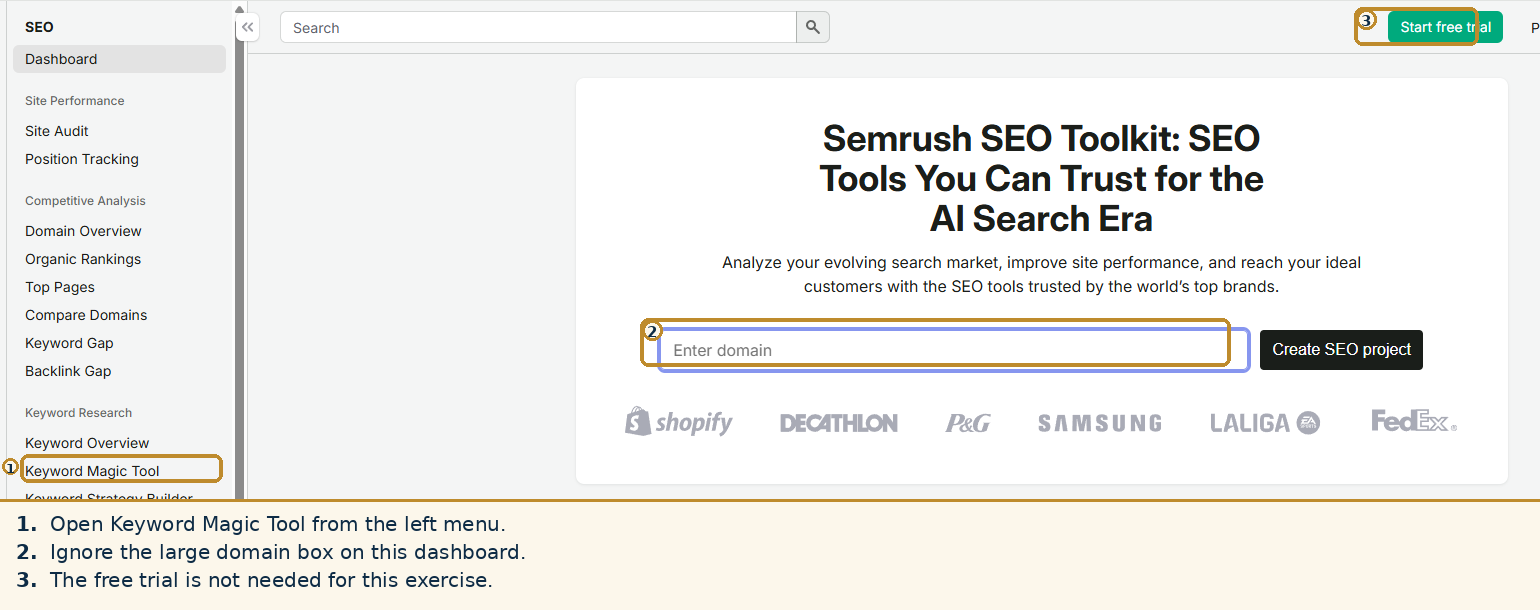
Semrush may open on this dashboard. Ignore the domain box and the trial button. Open Keyword Magic Tool from the menu on the left.
At the time of writing, the free plan allows 10 keyword-research searches per day, and the Keyword Magic Tool shows 10 results per report. Every new search counts toward that daily limit. Check the current free-account limits.
Ten searches should be enough for most shortlists.
They can also disappear quickly when the first wording does not work. If you reach the limit, save the worksheet and continue the next day.
Enter the seed keyword:
senior cat toys
Leave the optional domain field blank.
Choose the country where most of the people you hope to reach live, then run the search.
The country matters because Semrush shows keyword information for the country database you select. People in different countries may also use different words for the same product or problem.
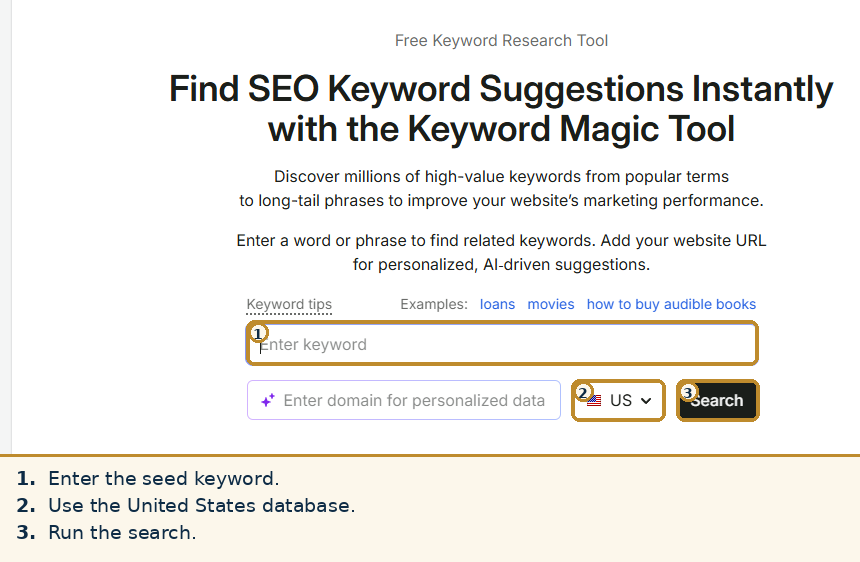
Enter the seed keyword, leave the optional domain field blank, choose the country and run the search.
Do not let the results table scare you
Semrush has given a fairly simple job a great many columns.
We do not need most of them.
For Part 1, keep your eyes on three things:
the keyword
Volume
KD%
Each keyword has its own row. The numbers in that row belong to that keyword.
That becomes important when we fill in the worksheet.
The results table
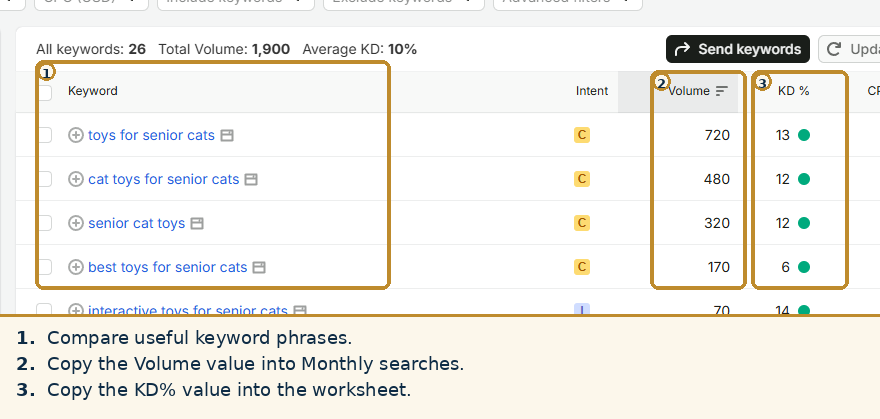
Each keyword has its own row. The Volume and KD% beside it belong to that keyword.
Our free report found 26 keyword suggestions and showed the first 10. We only need a few that fit the niche.
If you see Personal KD%
The Keyword Magic Tool may also offer Personal KD% when a website domain is entered.
That score is calculated for a particular website. We do not have a site for the new niche yet, so leave the optional domain field blank and use the general KD% column for this comparison. Read the difference between KD% and Personal KD%.
Read the keywords before the numbers
This part is easy to skip.
Do not skip it.
Semrush may give us keywords such as:
toys for senior cats
cat toys for senior cats
senior cat toys
best toys for senior cats
interactive toys for senior cats
Those all belong somewhere inside the market we are considering.
It may also give us a phrase about kittens with a much larger number beside it.
It is still about kittens.
A large number attached to the wrong market is not suddenly useful.
First, find the keywords that fit the niche.
Then look at the numbers beside them.
What does Volume tell us?
Volume is Semrush’s estimate of how many times people search for that exact keyword during an average month in the country we selected. Read Semrush’s explanation of Volume.
The row for toys for senior cats shows a Volume of 720.
That means Semrush estimates that the phrase is searched about 720 times during an average month.
It does not mean 720 people will visit our website.
It does not mean 720 people will buy anything.
Useful information. Not a prophecy.
A larger Volume can be encouraging, but only when the keyword still fits.
The broad phrase cat toys may have far more searches than toys for older cats. It also includes kittens, young cats and every other cat that enjoys knocking things under the refrigerator.
More searches are useful.
More searches from the people we hope to help are better.
What does KD% tell us?
KD% stands for Keyword Difficulty.
It is Semrush’s estimate of how much SEO effort it may take for a page to reach Google’s top ten results for that keyword. The score runs from 0 to 100. A higher number means Semrush expects the keyword to be more difficult. Read Semrush’s explanation of KD%.
A lower number generally gives a new website an easier place to begin.
A higher number usually means stronger, more established websites already occupy the first page.
That does not make the keyword useless.
It tells us the road may be longer.
A low Difficulty may belong to a keyword with almost no searches. A high Difficulty may belong to a strong market with easier, more specific keywords underneath it.
Neither number gets to make the decision by itself.
We explain why reaching Google’s first page matters in:
[Foundations: How Google Search Works]
Choose the Phrase to Compare
Now return to the keywords that actually fit the niche.
We are looking for one that gives us a useful balance:
it belongs to the niche
people appear to search for it
the Difficulty gives a new website some hope of getting noticed
The keyword with the highest Volume may also have the toughest Difficulty.
The one with the lowest Difficulty may have almost no searches.
There is no prize for choosing the largest or smallest number.
We want the phrase that gives us the better place to begin.
Our seed keyword was:
senior cat toys
Semrush showed a Volume of 320 and a KD% of 12 for that phrase.
It also showed:
toys for senior cats
That phrase has a Volume of 720 and a KD% of 13.
Both fit the niche. Toys for senior cats gives us considerably more search activity for only one extra point of Difficulty, so we will use it as our Phrase to compare.
Once you choose the phrase, stay on that row.
Copy three things from the same row:
the keyword into Phrase to compare
its Volume into Monthly searches
its KD% into Difficulty
| Niche idea | Phrase to compare | Monthly searches | Difficulty | Other useful phrases | Decision |
|---|---|---|---|---|---|
| Indoor enrichment for older cats | toys for senior cats | 720 | 13% |
The phrase, Volume and KD% travel together.
Do not take the Volume from one row and the Difficulty from another because both numbers looked nicer.
That would give us a very attractive answer to a question Semrush never answered.
When the first search misses the market
Sometimes the seed keyword gives us very little that fits.
That may mean the niche is weak.
It may also mean the wording missed the mark.
Before setting the niche aside, try one natural variation.
For our example, we might change:
senior cat toys
to:
toys for older cats
or:
indoor cat enrichment
One sensible second search is usually enough for this first comparison.
We are checking the wording, not bargaining with Semrush until it gives us the answer we wanted.
Use the better set of results, choose the Phrase to compare and complete the row.
Save a few other useful phrases
Before leaving the results, save one to three other keywords that clearly belong to the niche.
For our example, those might include:
cat toys for senior cats
best toys for senior cats
interactive toys for senior cats
Add them to Other useful phrases.
| Niche idea | Phrase to compare | Monthly searches | Difficulty | Other useful phrases | Decision |
|---|---|---|---|---|---|
| Indoor enrichment for older cats | toys for senior cats | 720 | 13% | cat toys for senior cats; best toys for senior cats; interactive toys for senior cats |
We are not collecting everything Semrush offers.
It will happily give us more than we need.
One to three is enough.
A phrase may point toward a product, a question or a problem someone wants help solving.
Part 2 will take a closer look at them.
Build the other rows
You may already have been working on one of your own niches beside the older-cat example.
If not, begin with whichever idea interests you most.
Use the same process:
choose a sensible seed keyword
search it in Semrush
choose the Phrase to compare
copy the Volume and KD% from that phrase’s row
save one to three other useful phrases
Then move to another niche.
There is no special order.
Leave the Decision column blank until all the rows are finished.
A niche can look impressive while it is sitting by itself.
Beside the others, it has to earn its place.
Compare the rows
Once the table is complete, look across the niches.
One may have plenty of searches, but every useful phrase looks difficult.
Another may have fewer searches, a more reasonable Difficulty and several connected phrases worth keeping.
A third may have one decent phrase and very little else.
No single number gets to choose the winner.
Now write Advance, Maybe or Set aside in the Decision column.
Advance
Compared with the other ideas, this niche gives us a useful phrase, visible search activity and a Difficulty that does not look completely out of reach.
It also gives us other phrases worth examining in Part 2.
Maybe
Something is there, but the choice is not clear.
The search activity may be modest, the Difficulty may be high or the useful phrases may be limited.
Keep it nearby when it comes close to the stronger choices or still gives you a good reason to continue.
Set aside
The other niches give us more to work with.
This one may have very few searches, difficult phrases, poor matches or almost nothing useful beyond the first result.
Set aside does not mean it could never work.
It means another idea has given us a better reason to continue today.
Take two or three ideas into Part 2
The ideas marked Advance are the first choices for Part 2.
If more than three have an Advance, keep the two or three that came out strongest when you compared the rows.
If only one has an Advance, bring the strongest Maybe with it.
We began Stage 1 with a page full of possibilities.
Now we have two or three ideas that have survived the quick checks, the product search and their first meeting with Semrush.
That is enough for the next step.
Part 2 will look beyond one phrase and see what each finalist is really made of.
Continue to Worksheet 3, Part 2: Take a Closer Look
Worksheet 3, Part 2: Take a Closer Look
Part 1 left us with two or three finalists.
We chose one Phrase to compare for each niche, then saved a few other useful phrases beside it.
That gave us a better shortlist.
Now we want to know what is hiding underneath those first rows.
One strong keyword can flatter a niche. One awkward keyword can make a decent niche look worse.
A small group of connected searches gives us more to work with.
For each finalist, we will look at three to five phrases and ask:
What are people trying to find, and does this niche give us several useful ways to help them?
Turn to Part 2: Take a Closer Look in Worksheet 3: Compare and Choose.
Open Worksheet 3, Part 2: Take a Closer Look in a new tab
The landscape page places all three finalists beside each other. Each panel has room for three to five phrases:
| Search phrase | Intent | Monthly searches | Trend | KD% | CPC |
|---|
A What stands out? box sits beneath each panel. Use it after you have read the phrases together.
We will begin with indoor enrichment for older cats.
You can build one of your own finalist panels alongside the example or read ours first and return to yours afterward.
Bring over the phrases we saved
Start with the Phrase to compare from Part 1.
Then bring over the one to three phrases saved in Other useful phrases.
That should give us somewhere between two and four phrases.
We want three to five altogether.
If the phrases all cover the same small part of the niche, add one or two that show us something different.
A list made entirely of toy searches may tell us a great deal about toys and almost nothing about the other reasons someone may need help with an older cat.
We might also look for:
a question about keeping an older cat active
a product comparison
a problem the cat owner is trying to solve
another useful product inside the niche
Three to five phrases is enough to see a pattern without turning the worksheet into a separate hobby.
Our first panel begins like this:
| Search phrase | Intent | Monthly searches | Trend | KD% | CPC |
|---|---|---|---|---|---|
| [Phrase to compare from Part 1] | |||||
| [Useful phrase from Part 1] | |||||
| [Useful phrase from Part 1] | |||||
| [Optional additional phrase] |
What was the searcher trying to do?
The first new column is Intent.
Intent is the likely purpose behind the search.
It does not tell us the person’s age, income, location or anything else about who they are.
It tells us what they seem to be trying to accomplish when they type the phrase into Google.
Semrush uses four main types of search intent. You may see the full word or the letters I, N, C and T beside a keyword. Read Semrush’s explanation of search intent.
Informational
The searcher wants an answer or explanation.
how to keep an older cat active
That could become an article, guide or video.
Navigational
The searcher is trying to reach a particular brand, website or page.
Chewy senior cat toys
That person may already know where they want to go. The phrase can still teach us something about the market, but it may give us less room to help.
Commercial
The searcher is comparing products or researching choices before buying.
best toys for older cats
That could lead to a comparison, review or buying guide.
Transactional
The search suggests that someone may be close to taking action or making a purchase.
buy senior cat puzzle feeder
That search is much closer to a sale.
Write the Intent shown by Semrush beside each phrase.
We are not trying to collect one of every type.
We want to see what is happening inside the niche.
Are people asking questions we could answer? Are some comparing products? Are any of the searches getting closer to a purchase?
Those give us different ways to help the same audience.
Add the numbers from the same row
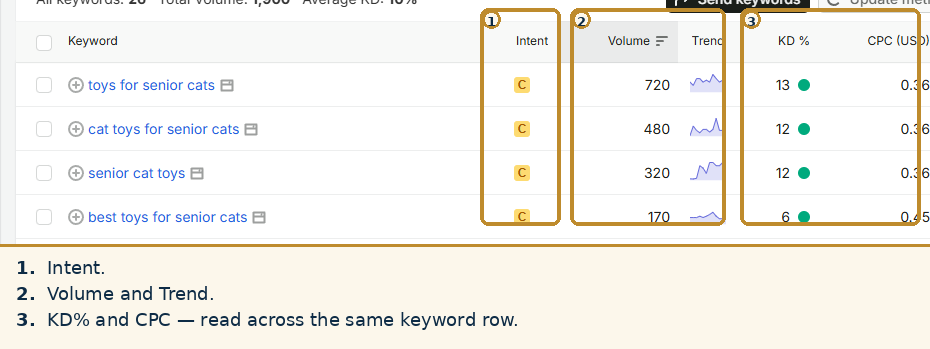
The same row gives us the keyword’s Intent, Volume, Trend, KD% and CPC.
We already used Volume and KD% in Part 1.
For each phrase:
copy Volume into Monthly searches
copy KD% into Difficulty
Both numbers must come from the same Semrush row as the phrase.
Now we can add the two new columns: Trend and CPC.
Read the little Trend graph
The Trend bars show how interest in that keyword has moved during the last 12 months. Read Semrush’s explanation of Trend.
We already looked at the wider market in Google Trends.
This time, we are looking at each phrase separately.
Write the closest pattern in the Trend column:
Growing
Steady
Seasonal
Declining
Unclear
One phrase may be steady while a particular product rises sharply at Christmas. Another may have grown for a year and then slipped back.
The little graph will not tell us why.
It gives us a reason to notice.
What does CPC tell us?
CPC stands for Cost Per Click.
It is Semrush’s estimate of the average price advertisers pay when someone clicks a Google ad connected to that keyword. Read Semrush’s explanation of CPC.
We are not planning to buy advertisements here.
We are using CPC as another clue.
When companies are paying for clicks around a search, there is usually a business reason behind it. They may be selling a product, gathering leads or trying to reach someone who is close to buying.
That does not mean a high CPC will make our website profitable.
It means advertisers appear willing to spend money to reach people making that search.
A low CPC does not kill the phrase either.
Some useful informational searches have little advertising around them. They may still become excellent articles that bring the right people to the website.
Copy the CPC from the same row as the phrase.
Add a note when something stands out
After the three to five phrase rows are complete, use the What stands out? box beneath the finalist panel.
A few words are enough:
good article question
clear product searches
useful comparison
strong fit, high KD%
several phrases aimed at one brand
different parts of the niche
possible buying guides
The note should help you remember what the group of phrases says about the finalist.
It does not need to become a diary entry.
Build the first finalist panel
Everything we have done so far belongs to one finalist:
Indoor enrichment for older cats
Fill in the three to five rows for that niche before moving to the next one.
The finished panel will look like this:
| Search phrase | Intent | Monthly searches | Trend | KD% | CPC |
|---|---|---|---|---|---|
| toys for senior cats | Commercial | 720 | Steady | 13% | $0.36 |
| cat toys for senior cats | Commercial | 480 | Unclear | 12% | $0.36 |
| best toys for senior cats | Commercial | 170 | Steady | 6% | $0.45 |
| interactive toys for senior cats | Informational | 70 | Growing | 14% | $0.33 |
Beneath it, What stands out? might say:
Strong close-fitting Volume, two useful comparison phrases and one informational direction.
Read the first finalist panel
Start with the phrases themselves.
Do they stay inside the niche, or did one useful keyword lead Semrush somewhere else?
Do we have questions we could answer?
Do we have product searches or comparisons that could lead naturally to useful recommendations?
Now look at Monthly searches and Difficulty.
Is there at least one phrase with enough activity to interest us and a KD% that gives a new website a reasonable place to begin?
Or does every phrase that fits the niche look difficult?
Look at Trend and CPC too.
Has interest held up? Do advertisers appear willing to pay for clicks around any of the product or comparison searches?
None of these columns chooses the niche by itself.
Together, they tell us whether the finalist is more than one lucky keyword.
A useful older-cat panel might give us:
a question that could become a guide
product searches that could become comparisons
at least one close-fitting phrase with a more approachable KD%
interest that has held up
CPC beside one or two commercial searches
That would give us several ways to help the same general audience.
We could answer questions, explain the choices and recommend products when they genuinely fit.
What might give us second thoughts?
A finalist may look weaker when:
the useful phrases all lead to the same narrow product
the phrases barely fit the niche
every close-fitting phrase has a discouraging KD%
interest appears to be fading
the searches reveal very little commercial activity
most of the useful phrases belong to a different market
One weak column does not automatically end the niche.
We are looking at the pattern across the table.
Build the other finalist panels
Take the next finalist and build its panel the same way.
Give each niche its own panel.
For each one:
bring over the Phrase to compare
bring over the useful phrases saved in Part 1
add another phrase only when it shows a different question, product or problem
fill in Intent, Monthly searches, Trend, KD% and CPC
summarize the group in What stands out?
Finish one finalist panel before moving to the next.
Compare the finalist panels
Once all three panels are complete, they are already beside each other.
Which niche gives us several phrases that clearly fit?
Which one gives us useful questions, product searches or comparisons rather than several versions of the same idea?
Which one offers at least one reasonable place for a new website to begin?
Which one shows interest that has held up?
Which one gives us some sign that businesses are willing to spend money reaching the audience?
We are not adding the columns into a final score.
A niche with the most searches may also be much harder to enter. Another may have lower numbers but clearer questions, better product searches and a more useful place to begin.
Read the tables as evidence, not a contest where the largest number wins.
Bring the strongest one or two forward
Choose the strongest finalist.
Bring a second one when the comparison is close or the two niches have different strengths worth checking.
Do not carry three forward simply because setting one aside feels rude.
The Final Business Check has a different job.
It will ask whether these search patterns connect to useful products or services, possible affiliate programs, enough content to build and people we may genuinely be able to help.
Continue to the Final Business Check
Final Business Check: Products, Content and a Practical Way to Earn
Worksheet 2 showed us that products or services exist.
This time, name three to five of the strongest ones and see whether they give us a practical website to build around.
Then look for possible affiliate programs, make sure there is enough useful content to create and describe the people the niche may help.
This is not another round of keyword research.
It is the point where we ask whether the strongest niche works as a business idea, not only as a collection of searches.
Bring in the strongest one or two finalists from Worksheet 3.
Turn to Part 3: Final Business Check and Final Choice in Worksheet 3: Compare and Choose.
Open Worksheet 3, Part 3: Final Business Check and Final Choice in a new tab
The strongest one or two finalists sit beside each other. Each panel asks for:
useful products or services
possible affiliate programs
content possibilities
who the niche may help
willingness to keep going
an Overall view
We will continue with:
Indoor enrichment for older cats
Name the strongest products or services
Look back at the marketplaces, stores and searches you checked earlier.
Choose three to five products or services that clearly fit the niche and could genuinely help someone.
For older-cat enrichment, we might find:
puzzle feeders
gentle interactive toys
pet steps or ramps
scratching products
window perches
Add the strongest choices to Useful products or services.
Our first finalist panel now has:
Finalist niche: Indoor enrichment for older cats
Useful products or services: Puzzle feeders, gentle toys, pet steps, scratching products and window perches
Three to five is enough.
We are not trying to catalog the entire pet industry.
We want to know whether the niche gives us several useful things to explain, compare or recommend.
Not every niche leads to physical products
Another niche may lead to:
software
online courses
memberships
bookings
professional services
downloadable products
subscriptions
Use whatever people in that market genuinely pay for.
Look for possible affiliate programs
Now look at the companies, brands and retailers behind those products or services.
Search:
[company or store name] affiliate program
You can also check the bottom of the company’s website. Affiliate links often appear in the footer under names such as:
Affiliates
Partners
Referral Program
Work With Us
Affiliate networks may manage several programs in the same market.
We are not comparing commission rates, cookie periods, payment rules or application requirements yet.
Stage 3 will do that properly.
For now, we want to know whether there is at least one credible program to investigate later.
Record the company, program or network in Possible affiliate programs.
The same panel now has:
Possible affiliate programs: [Confirmed brands, retailers or programs]
Give the affiliate path a quick rating.
Clear
We found several useful products or services and at least one credible affiliate program.
Possible
The products or services are there, but the affiliate options still need checking.
Thin
We found few useful products or no clear affiliate program to investigate.
Add the rating beside the programs you found.
See what we could write about
Now move away from the stores for a moment.
Look at the questions, products and problems that kept appearing through Worksheets 2 and 3.
Could we turn them into useful articles, comparisons and guides?
For older-cat enrichment, the research may point toward:
how to keep an older cat active
signs that a senior cat is bored
gentle play for cats with limited mobility
puzzle feeders for older cats
pet steps compared with ramps
creating a safer indoor space for an older cat
Some answer questions.
Some help people compare products.
Some may naturally lead to a recommendation.
That gives the website more depth than a pile of product reviews written mainly because we would like someone to click a button.
We do not need 200 article ideas today.
We need enough to believe the website can continue after the first few pages.
Add the strongest directions to Content possibilities.
Then give the content path a quick rating.
Plenty
The niche gives us many questions, products, comparisons and useful guides.
Some
There is enough to begin, although the subject may become narrow later.
Limited
Most of the ideas lead back to the same product or question.
Our finalist panel may now include:
Possible affiliate programs: [Confirmed programs] — Clear
Content possibilities: Activity, boredom, mobility, product comparisons and small-space ideas — Plenty
Who might this help?
Before we finish the row, add a short description of the people most likely to benefit from the products and content we found.
This gives us a general audience picture to keep with the niche.
Use this pattern:
[specific people] who want or need [specific outcome]
For our example:
People caring for an older indoor cat who want to keep it active and comfortable.
For compact kitchen appliances:
People living in small apartments who want to cook without filling the kitchen with large appliances.
The first part identifies the people.
The second tells us what they want, need or are trying to solve.
We are not trying to describe every possible reader.
An answer such as everyone, men, women, parents or pet owners is only a broad label. It does not tell us what brought them to the niche.
Add the want, need or problem.
For example:
Women who want healthier-looking hair after menopause.
Men who want to build muscle at home without buying a room full of equipment.
Pet owners who want to keep an older indoor cat active and comfortable.
Add one short description to Who might this help?
We may use it later, but Stage 2 starts with the niche itself. For now, one useful sentence is enough.
Would you keep going?
There is one more person involved in this decision.
You.
You do not need to feel a deep spiritual connection to cat ramps, kitchen gadgets or accounting software.
You do need enough interest or willingness to keep researching after the excitement of choosing a niche has worn off.
Ask yourself:
Would I still be willing to read, learn and write about this several months from now?
Mark Yes, Maybe or No.
Yes
You are willing to keep learning and creating around the subject.
Maybe
You are interested, but something still gives you pause.
No
You would rather build around something else.
There is no advantage in choosing a promising market that you already want to escape from.
Compare the final rows
Complete both finalist panels before choosing an Overall view.
They are already beside each other, which makes the comparison easier.
One niche may have a clearer affiliate path. Another may give us much more useful content. A third may look solid on paper while leaving you with no desire to keep going.
Now choose an Overall view for each finalist.
Strong
The niche gives us several useful products or services, clear content directions, at least one credible affiliate program and a recognizable group of people we may be able to help.
You are willing to continue.
Promising
Most of the pieces are there, although one or two need more checking.
Uncertain
The niche shows some good signs, but an important part remains weak or unclear.
Weak
There are too few useful products, too little content, no believable affiliate path or no real willingness to continue.
The Overall view is not a mathematical score.
It is the judgement you make after reading the whole panel and comparing it with the other finalist.
Choose the provisional niche
Look across the final one or two panels.
Which niche gives you the strongest combination of useful products, possible affiliate programs, content ideas, people to help and willingness to continue?
Choose that one.
It does not need to win every column.
It needs to give you the better place to begin.
That becomes your provisional niche.
Provisional matters.
We have done enough research to move forward.
We have not signed a lifetime contract with the subject.
Finish your Stage 1 choice
At the bottom of the same page, write your choice in the final box:
My provisional niche is:
Then add the people you currently expect to help:
The people I hope to help are:
Now put the two together:
I plan to help [people] by creating useful content about [niche].
For our example:
I plan to help people caring for older indoor cats by creating useful content about keeping those cats active, comfortable and interested in their surroundings.
That sentence may change. Later research may give us better words or a clearer audience. For now, we have a niche worth taking to the next step.
Review and save your Stage 1 project
You now have several worksheets, a pile of notes and one provisional niche.
This is a good time to make sure the pieces agree with each other.
If you have been using the Atlas Niche Companion, type:
Run my final Stage 1 review.
The final review can help you:
organize the ideas and evidence
check that every worksheet column is complete
spot a conclusion that is not supported by the notes
compare the final niches without losing the reasons behind the choice
prepare a short summary for your own records
It cannot decide which niche you must choose.
That part still belongs to you.
If you have been following the tutorial with the printable worksheets instead, use the same list as your final check. You do not need to change paths now.
If you would like AI help with this final check, you can still set up the Atlas Niche Companion. That is optional.
When the review is complete, save:
your three worksheets
your final statement
the phrases you carried forward
the products, programs and content directions that supported the choice
We will use them again.