
“Go find your audience’s pain points.”
I’ve seen that instruction more than once.
I understood every word in it. I just didn’t know what I was supposed to do with it.
And then there’s the rest of the “advice”:
Find your audience. Read forums and reviews. Look for problems.
Which problems tell me something useful?
Which ones are just somebody having a bad Tuesday?
People complain about things. What does that have to do with the things they buy?
And at what point does any of this start looking like an affiliate business?
I think we’ve been told to start at the wrong end.
We are trying to build an affiliate business.
Affiliate businesses make money when people buy things.
So before I spend three days collecting complaints from strangers on Reddit, I would like to see what people can actually buy.
Bring your niche with you
Stage 2 Research Kit
The kit includes the printable Stage 2 worksheet and the Stage 2 Companion. Keep both open while you work through the tutorial.
Enter your email address below and I’ll send the Research Kit straight to your inbox.
For the worked example, I did something you don’t need to do.
I went through Stage 1 again.
Well, the Companion did. I mostly went along for the ride.
You already have a niche.
I wanted a different one, hopefully giving you another point of view while you work through yours.
I came out with:
Learning acoustic guitar as an adult beginner
Stage 1 got me far enough to say:
Okay. This might be worth looking at.
Not:
Quit your job. We found the mother lode.
Now I wanted to see what was actually inside it.
If you have the Stage 2 worksheet, open that too.
And open the Companion.
Just don’t turn the Companion loose yet.
It’s going to do most of the work.
But first I want you to find a few things yourself.
Something people buy. What it costs. Whether somebody will pay you if you help sell it. What the competition looks like.
Part of the reason is I want you to know how to do this yourself.
Mostly, though, I want you to know what all that stuff means when the Companion drops a small mountain of it in your lap.
So I went shopping
I started with Google.
I searched:
beginner acoustic guitar
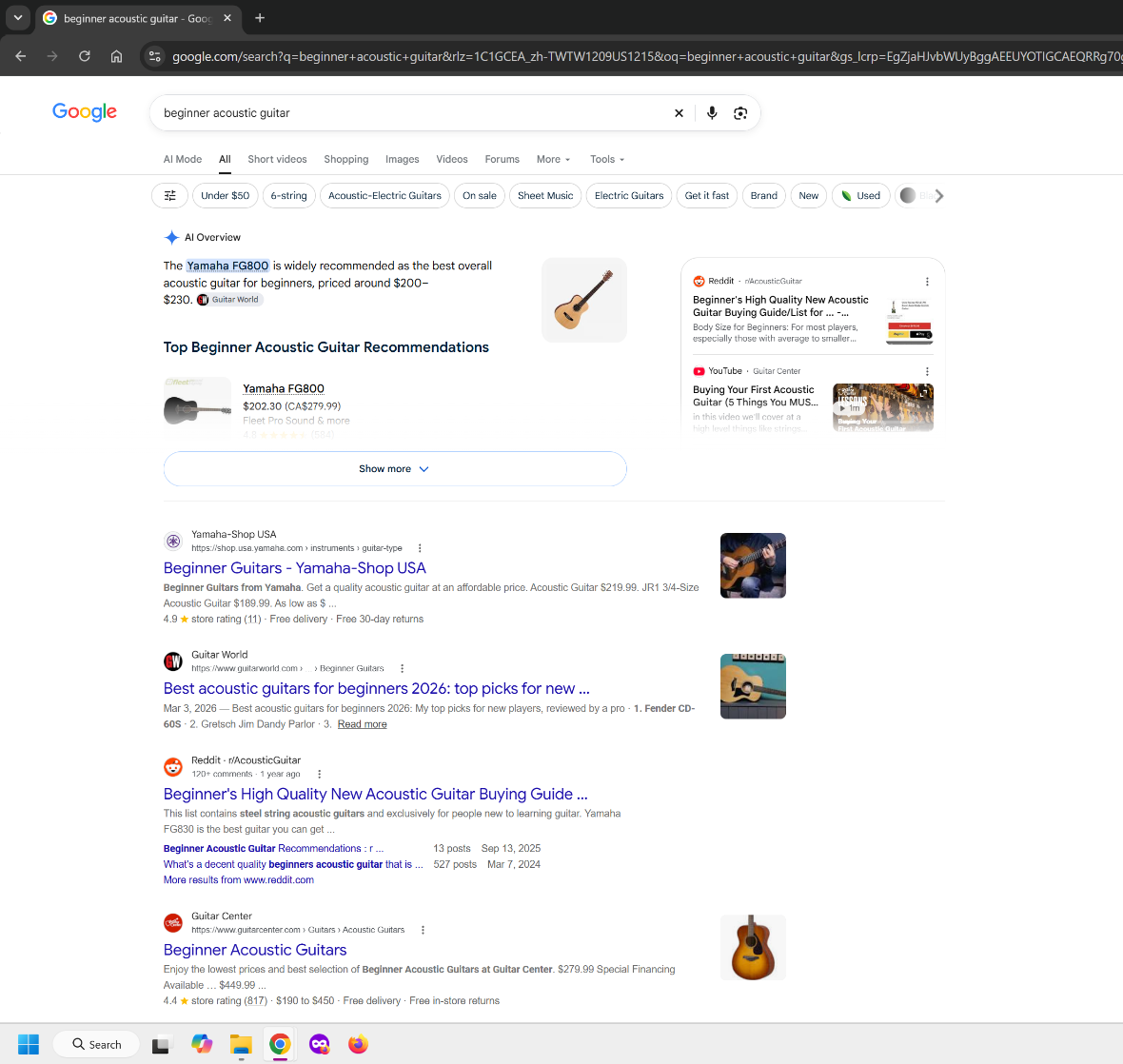
Guitars. Lots of guitars.
And buying guides telling me which guitar I should buy.
Fine. I already knew guitars were part of the market.
What else does a beginner spend money on?
I searched:
beginner acoustic guitar accessories
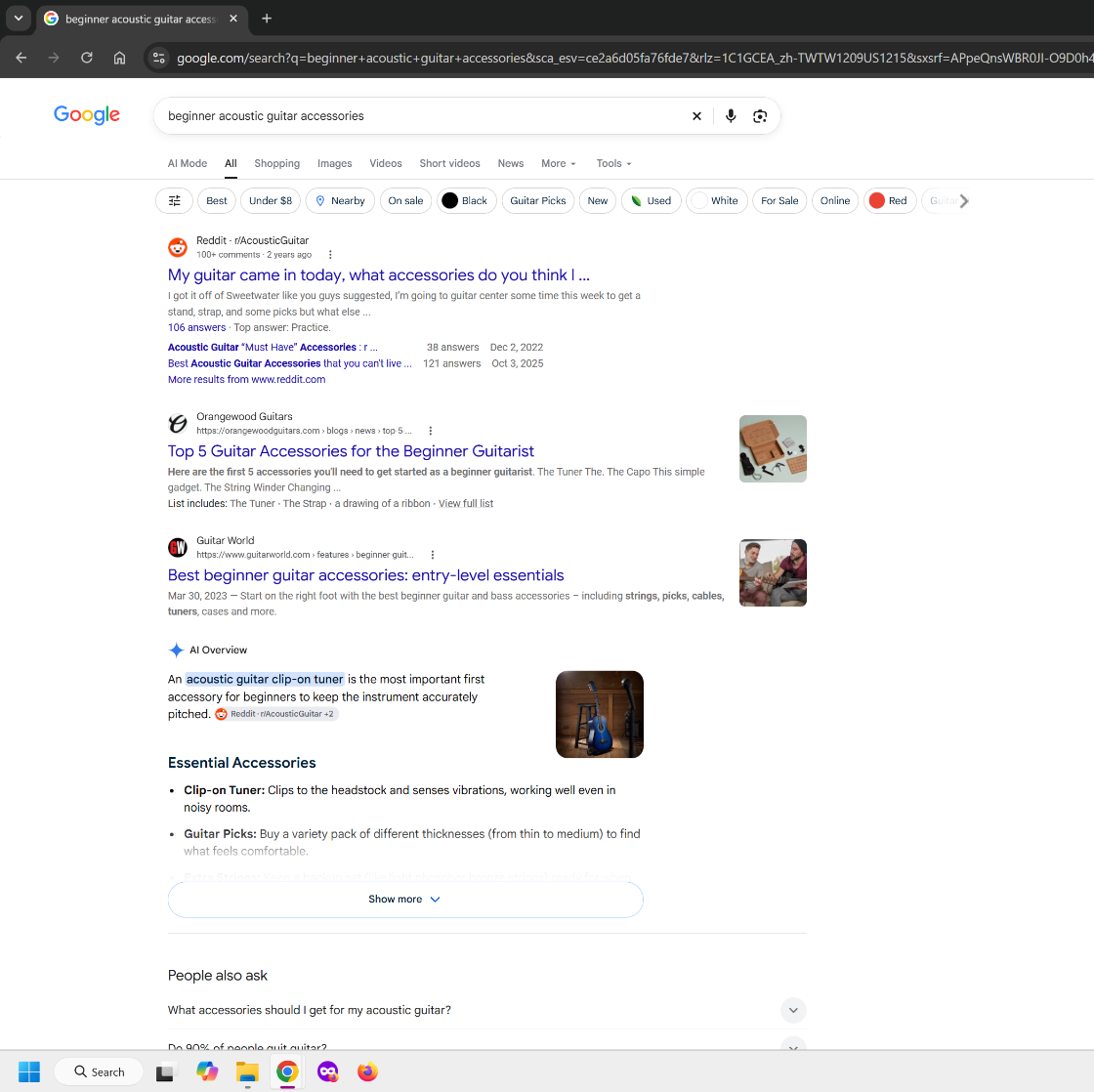
That opened things up.
Tuners. Capos. Strings. Picks. Gig bags. Stands. Starter packs.
Now I was getting somewhere.
Google had plenty more products, but one of the specialist stores that kept coming up was Gear4music.
I clicked in and started scrolling.
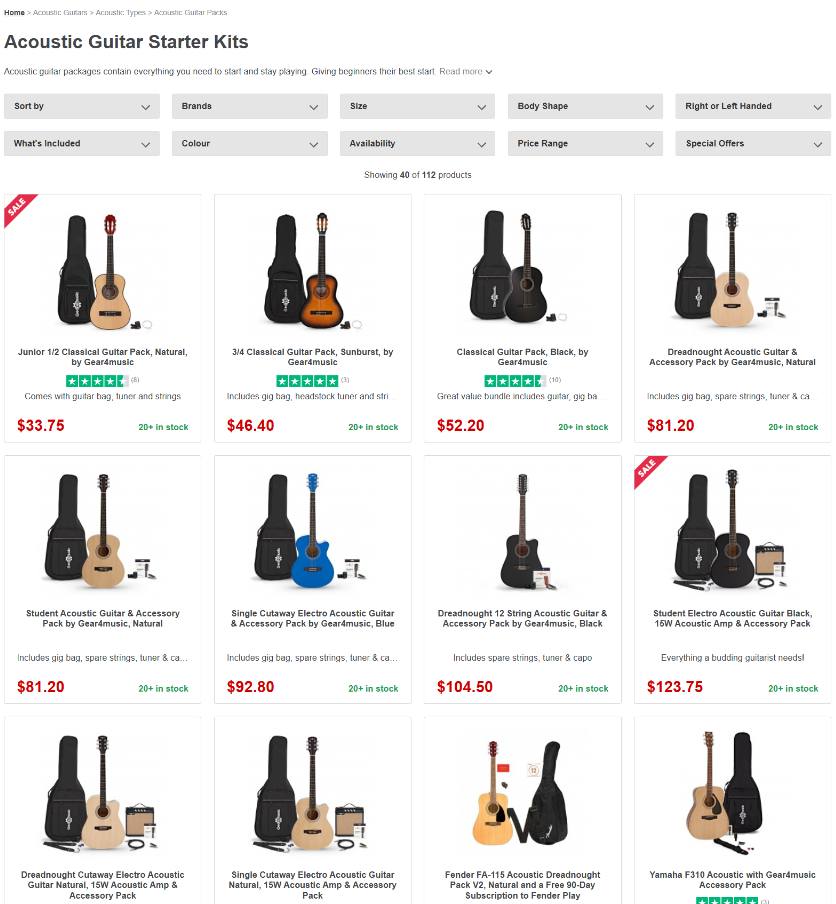
More than 100 acoustic starter packs in one section.
Some were under $50. A Student Acoustic Guitar & Accessory Pack was $81.20. Packs with amps were over $120, and then there were more expensive guitars sitting right beside them.
Okay.
People could spend a little here or quite a lot.
Then I started noticing all the stuff wrapped around the guitar itself.
Different sizes. Left-handed versions. Acoustic. Electro-acoustic. Bags. Strings. Tuners. Picks. Stands.
And something called a capo.
A capo? No idea.
Thirty seconds later I knew enough.
It’s a little clamp that goes across the strings on the neck and lets a guitarist change the key while keeping familiar chord shapes.
Got it. Trivia satisfied.
Meanwhile, lessons, courses, apps and memberships had been showing up in the other searches.
My simple “beginner guitar” niche was getting bigger every time I clicked something.
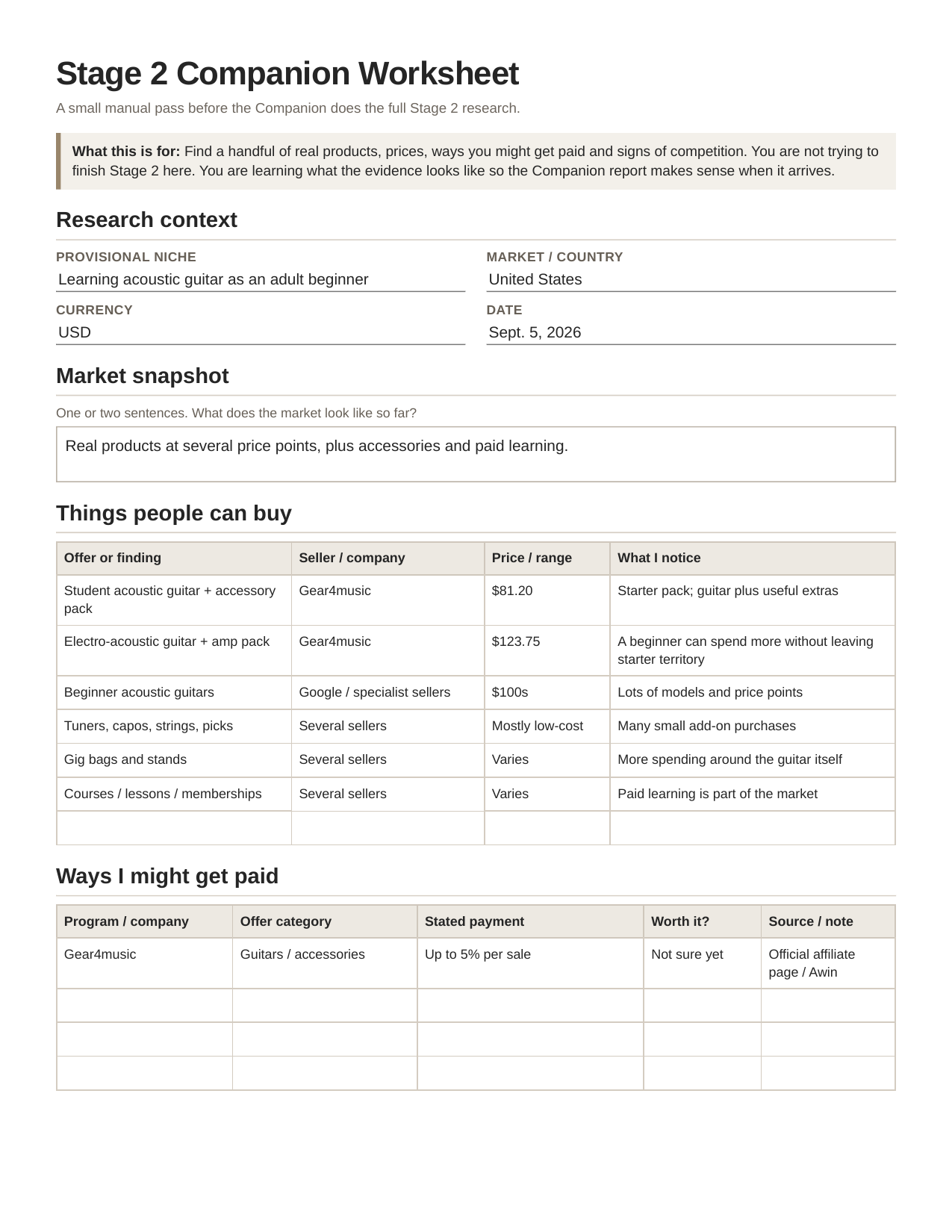
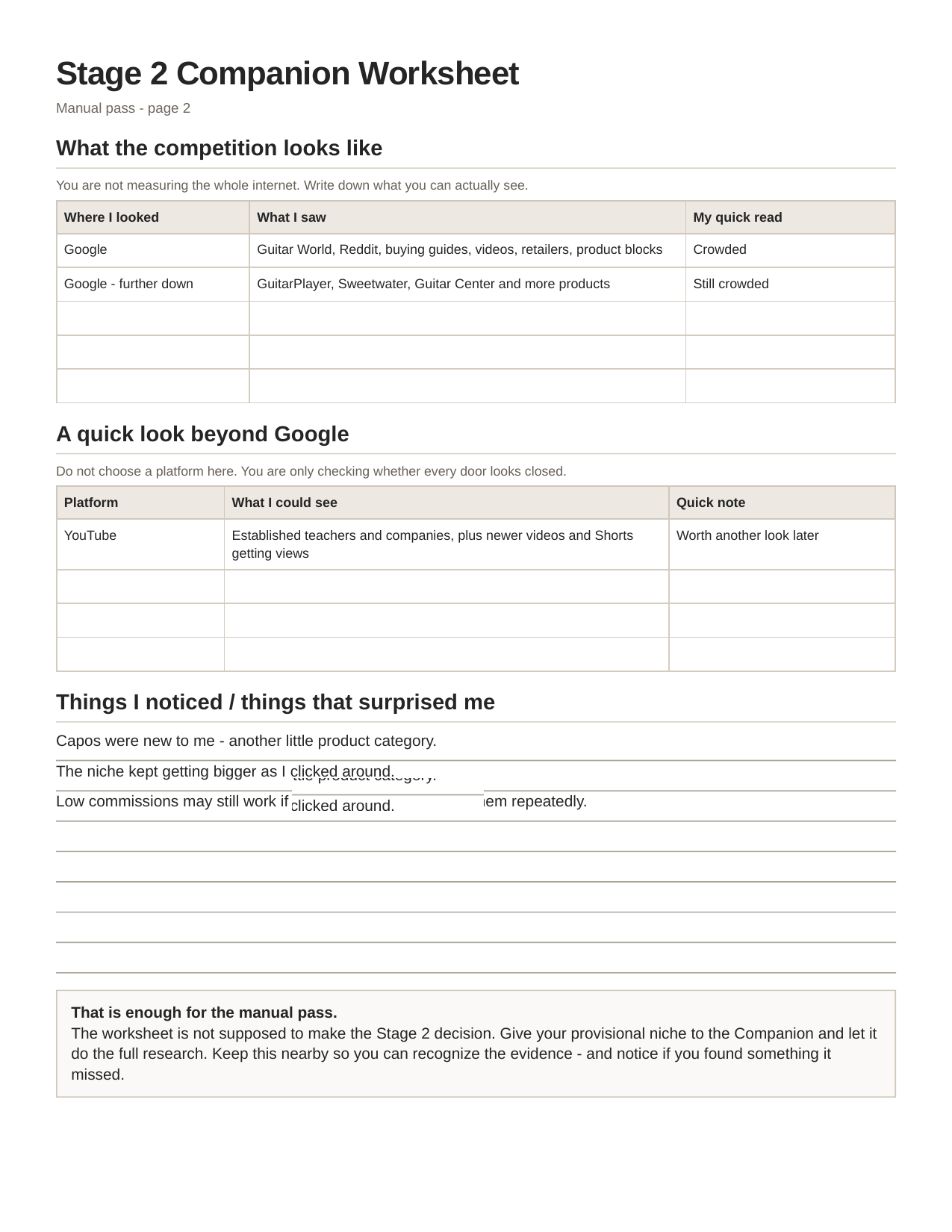
I started putting what I found on the worksheet. Nothing fancy. I just wanted the products, prices and other useful bits somewhere I could see them together.
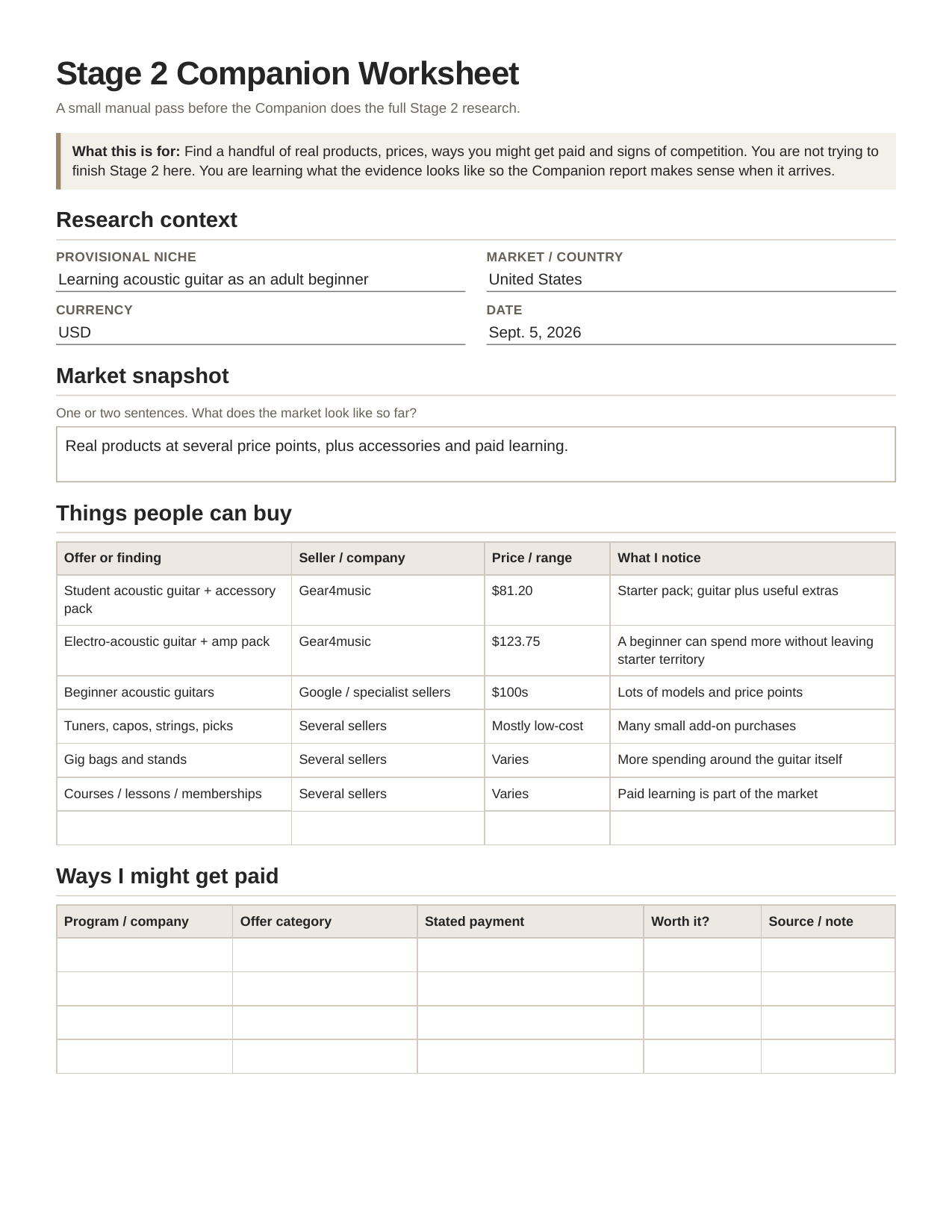
Student acoustic starter pack — Gear4music — $81.20 Starter packs with amps — Gear4music — over $120 Beginner guitars — several prices Accessories — strings, tuners, capos, picks, bags, stands Learning — courses, lessons, apps, memberships
That was enough to get started.
Your turn
This is probably a good place to stop watching me shop and go make a small mess of your own.
Take the niche you brought from Stage 1 and search the obvious thing somebody might buy.
Don’t get clever yet.
I searched beginner acoustic guitar because I wanted to see beginner acoustic guitars. Then I searched accessories because I wanted to know what else those beginners were buying.
That’s about as sophisticated as this needs to be.
If Google gives you Shopping results, have a look. If Amazon or Etsy keeps showing up, look there too.
Then find somebody who specializes in whatever you’re researching.
The big general stores showed me guitars.
Gear4music showed me just how many different ways somebody could spend money once they got inside the subject.
That was more useful.
Click around. Get nosy.
Write down the things that make you stop for a second.
Oh. They sell that too.
People pay that much for this?
There are twelve versions of the same thing?
You do not need to catalogue the internet.
Once I had a decent spread and started seeing the same kinds of things again, I stopped.
Get yours far enough that the market is starting to have a shape.
Then come back.
Four bucks?
I had an $81.20 starter pack.
Now for the question I actually cared about: would Gear4music pay me if somebody bought it through my link?
I searched:
Gear4music affiliate program
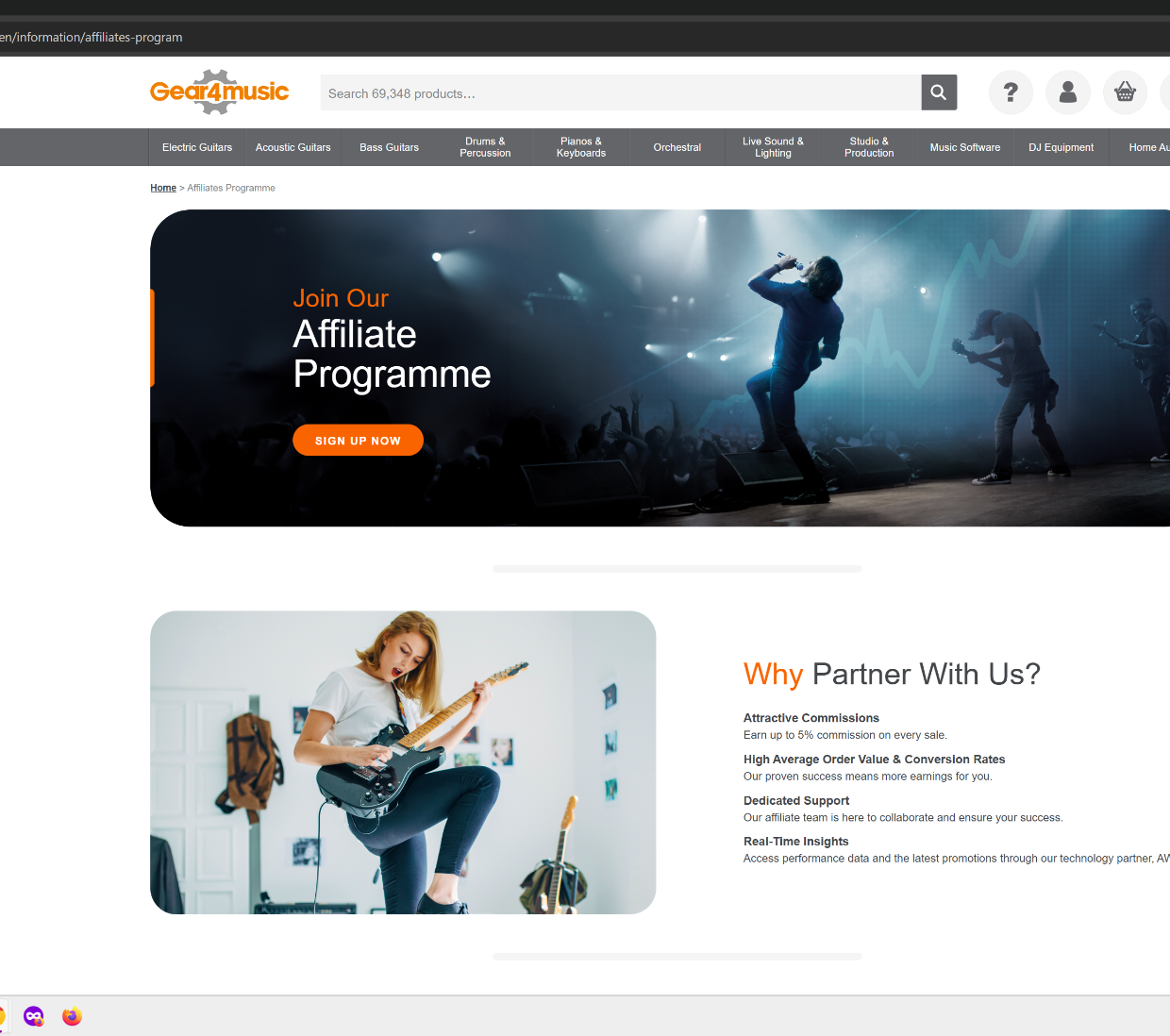
Up to 5% commission on sales.
So, in theory:
$81.20 × 5% = $4.06
Hmm. Four bucks.
Not terrible.
Not exactly setting my wallet on fire either.
One of the packs with an amp was $123.75.
At the full 5%:
$6.19
Okay. Still not yacht money.
But then I looked back at all the guitars that cost hundreds of dollars.
Five percent could get more interesting depending on what somebody bought.
Gear4music went on the worksheet.
Guitar lessons had been popping up since the first search.
Might as well see if there was money there too.
I searched:
online guitar lessons for beginners
TrueFire came up.
Courses. Private lessons. An All Access membership.
Okay. Do they pay affiliates?
I searched:
TrueFire affiliate program
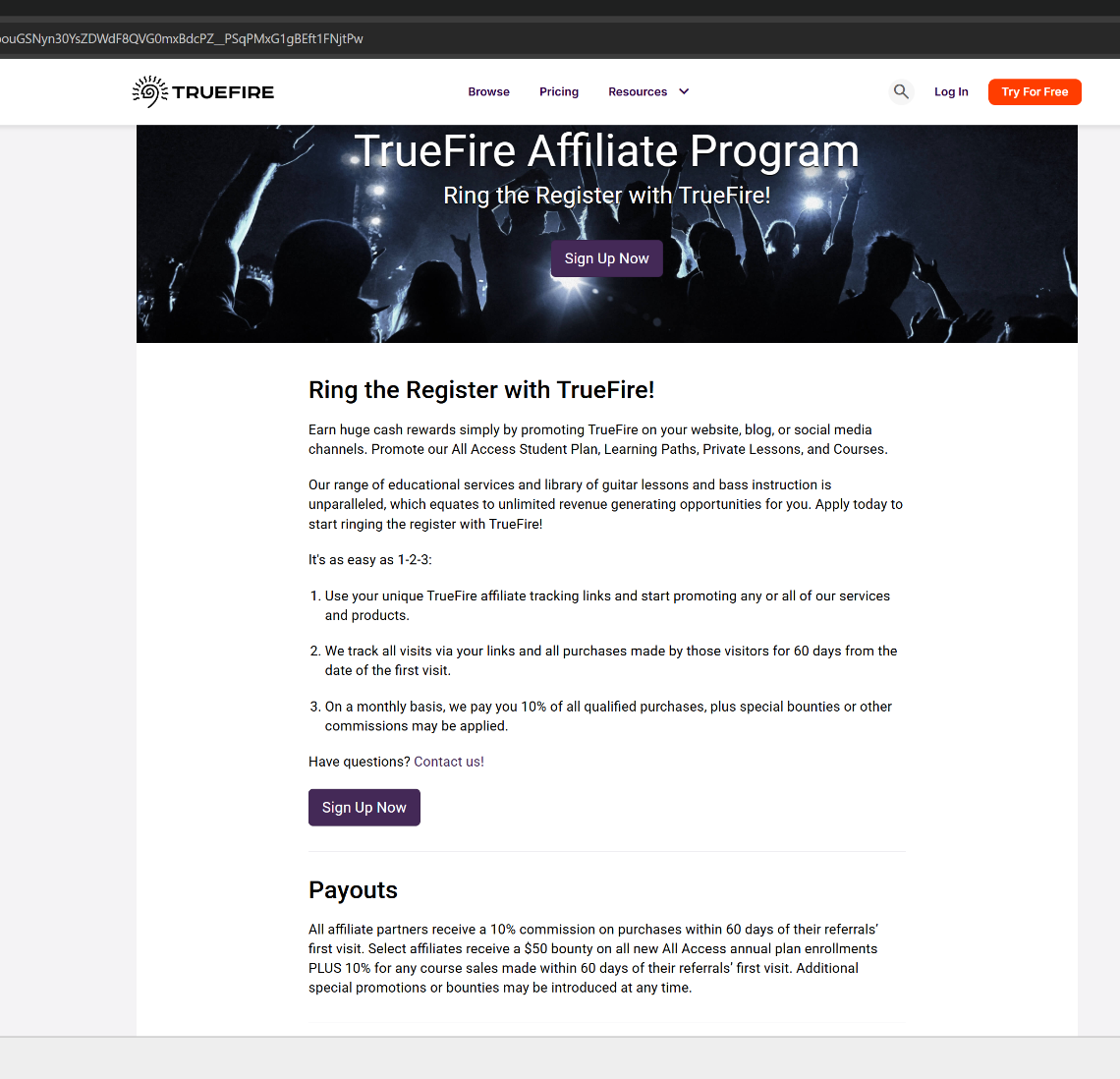
They did.
Ten percent on qualifying purchases.
Better than Gear4music.
Then I found the interesting part.
Some affiliates could qualify for a $50 bounty when somebody signed up for a new annual All Access membership.
I couldn’t count on the fifty dollars. Not everybody gets it.
But now I had another kind of offer and another way to get paid.
A beginner might buy an $81 starter pack and earn me about four dollars. The same beginner might also buy lessons or a membership and earn me something completely different.
TrueFire went on the worksheet too.
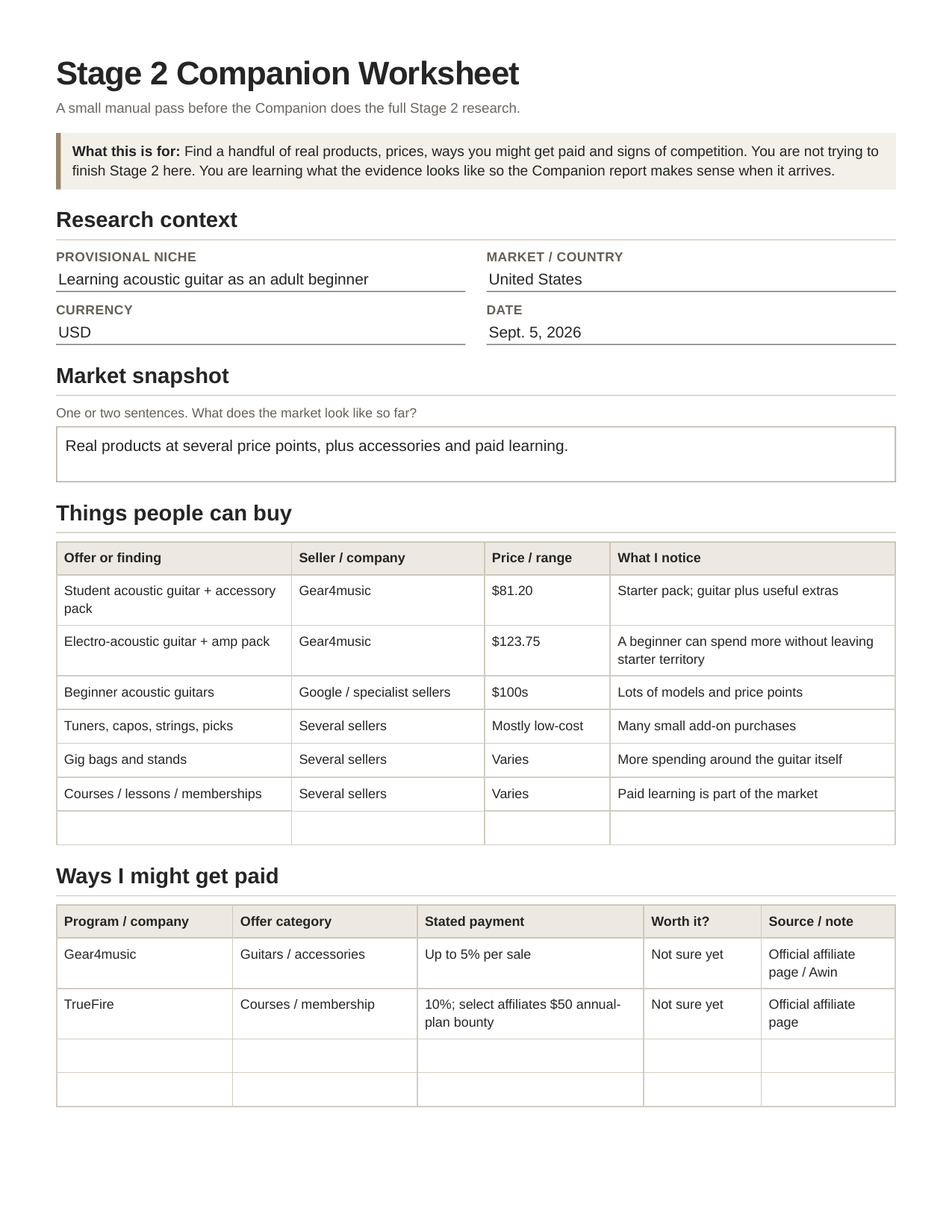
I still had no idea how much money I could actually make with any of this.
That wasn’t really the question yet.
I wanted to know whether there were enough real ways to get paid to keep looking at the niche.
So far, there were.
Now I wanted to see who else had noticed.
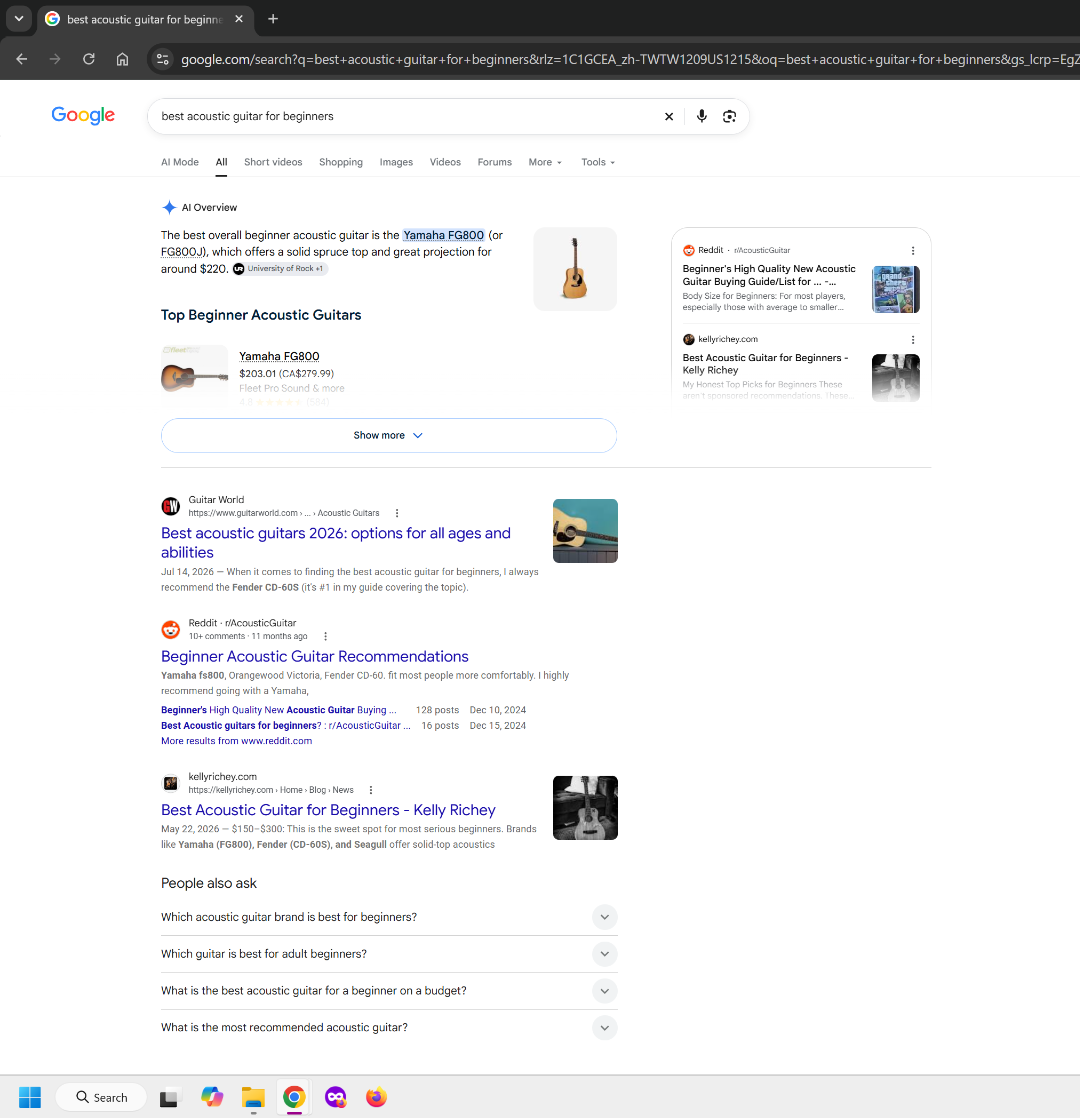
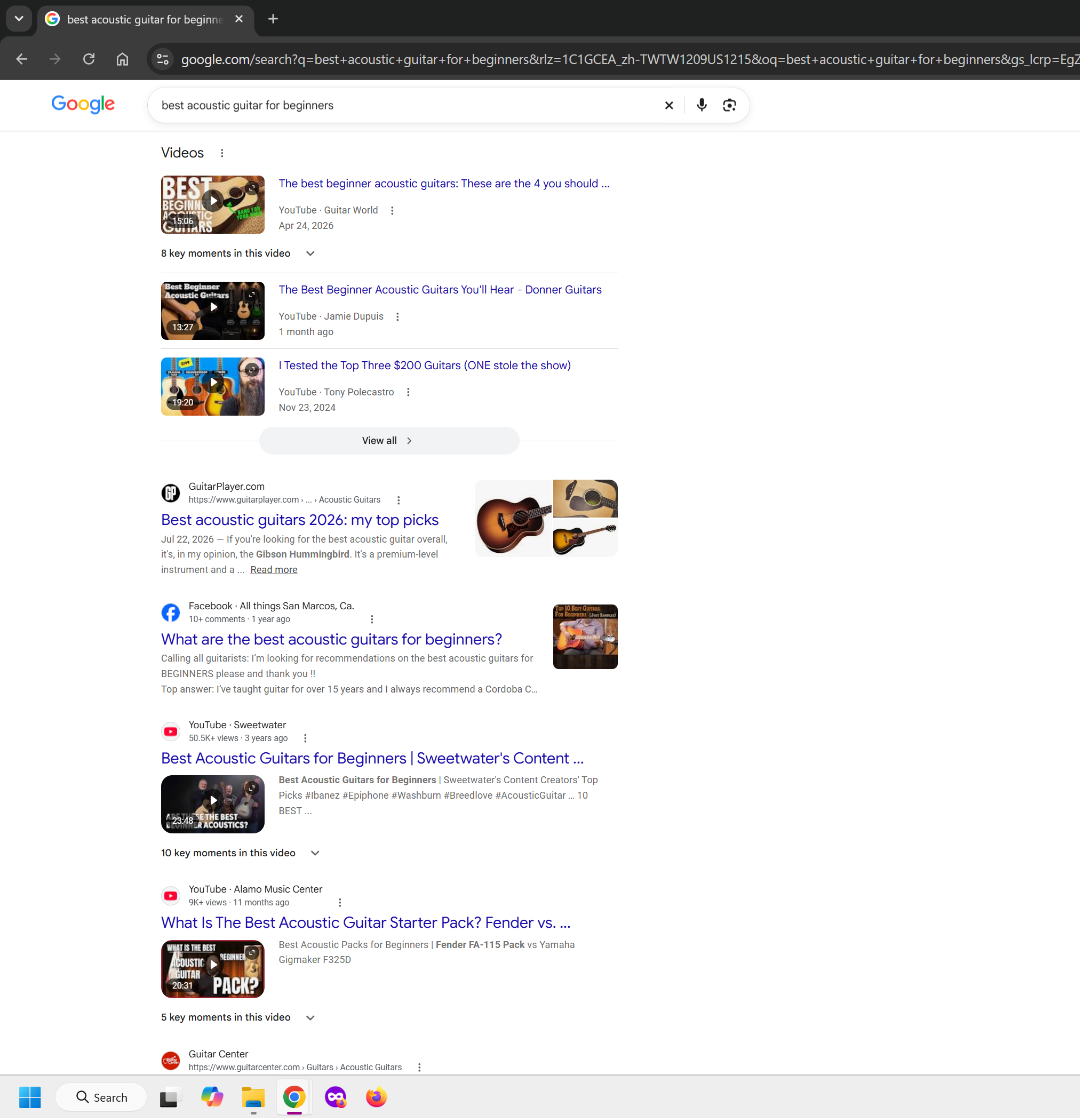
I searched:
best acoustic guitar for beginners
Apparently, quite a few people
Guitar World.
Reddit.
More buying guides.
Then videos. GuitarPlayer. Sweetwater. Guitar Center. More products.
Well, damn.
My first thought was:
Maybe we’re too late.
Then again, I’d just spent all this time proving people bought things here. Of course other people had noticed.
The question was whether there was any room left for me.
Still, this was crowded.
I wrote:
Google — obvious beginner-guitar buying searches look crowded
Just because Google was a dead end didn’t mean the niche was dead.
Other platforms might have more wiggle room.
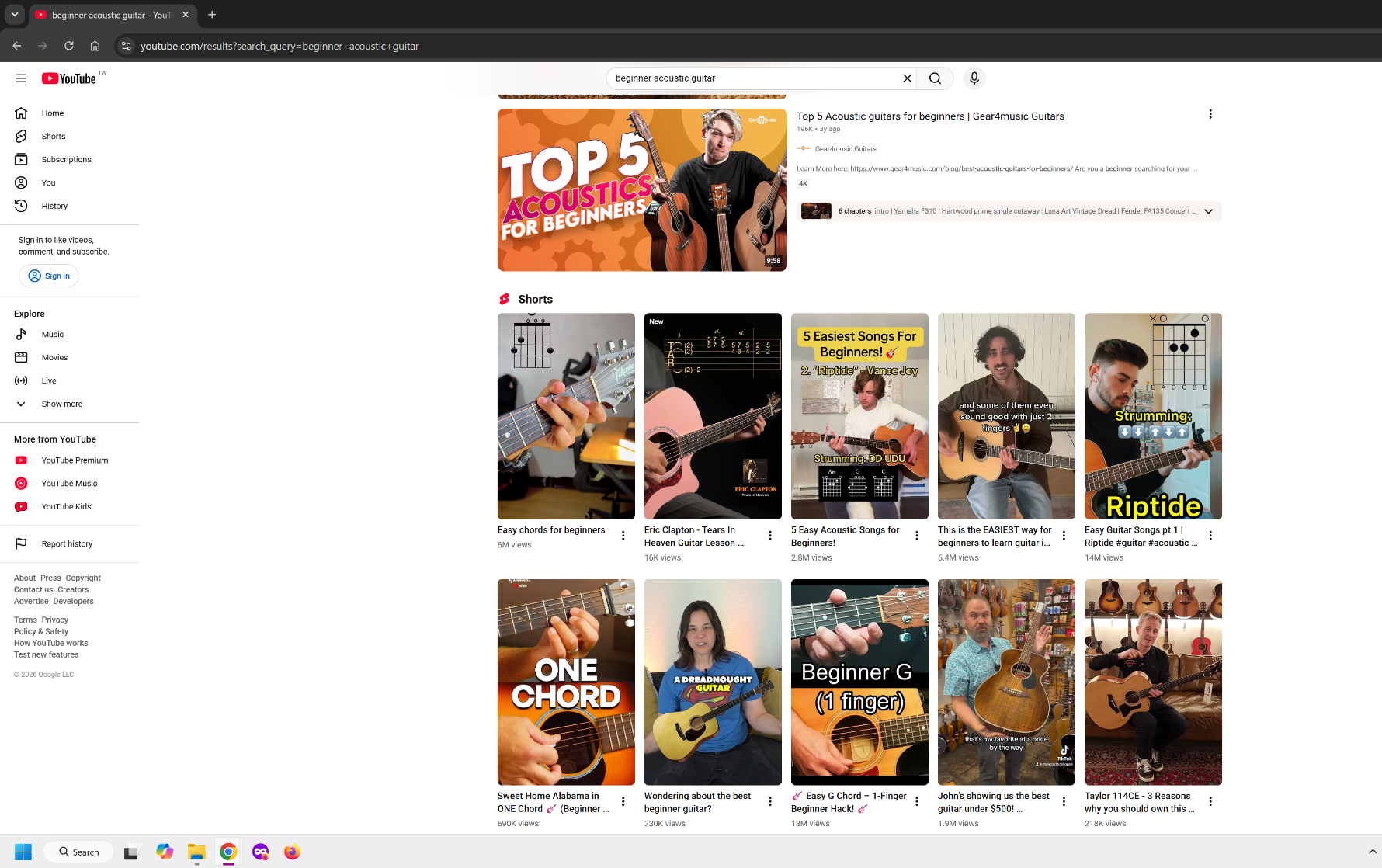
Let’s check YouTube.
There were plenty of established guitar teachers and music companies there too, but I also found newer videos and Shorts getting views.
Better.
That doesn’t mean YouTube would be easy. I have no idea yet.
But Google wasn’t the whole story.
I added that to the worksheet:
Google — obvious beginner-guitar buying searches look crowded YouTube — established teachers and companies, plus newer videos and Shorts getting views; worth another look later
You also might find your opening somewhere else entirely.
Instagram. TikTok. Reddit. Pinterest. Whatever makes sense for your niche.
Go have a look, especially if you already use one of them.
Just don’t go signing up for all of them.
We’re not choosing where to build yet.
For now, we just want to know whether every door looks closed.
For us, they didn’t.
You can niche yourself into a closet
Competition makes another idea look pretty attractive:
Just niche down.
Suppose we have:
Dog treats for older dogs
Lots of buyers. Lots of products. Lots of companies.
And probably lots of competition.
So we narrow it:
Dog treats for older poodles
Maybe.
Then:
Organic dog treats for older miniature poodles with sensitive teeth
If I keep going, eventually I can get rid of every competitor.
Unfortunately, I may also get rid of every customer.
Narrowing can give us a better opening.
It can also leave us proudly owning a market consisting of Doris in Ohio.
A dollar can be great
The four dollars from Gear4music was still bothering me.
Was that good?
I honestly didn’t know.
Let’s make it worse.
Say I find a guitar-pick program that pays me $1 per sale.
One dollar.
If I spend four hours researching one particular pick and write a 1,500-word article hoping somebody buys it, that dollar is terrible.
But what if I make one useful page with a hundred different picks on it?
Now the same page could earn that dollar over and over without me starting from scratch every time.
Same commission.
Very different setup.
The four dollars from the starter pack worked the same way.
One useful page comparing five beginner starter packs could earn that four dollars again and again.
Then there was TrueFire’s possible fifty-dollar bounty.
Fifty sounded much better.
But if it took fifty times more work to earn, maybe it wasn’t.
I didn’t know what any of that work would look like yet.
The worksheet had one more box beside the commission:
Worth the effort?
I left it at:
Not sure yet.
But now I knew the commission alone wasn’t enough.
I had enough tabs open
Skipped the kit earlier? Open the Stage 2 Research Kit request form.
By now I had guitars, accessories, lessons, prices, affiliate programs, commissions and competition scattered across more tabs than I cared to count.
And the occasional capo.
I’d found enough to know there was a real market here.
What I didn’t know was how much I was missing.
I could keep opening tabs one at a time.
Or I could get some help.
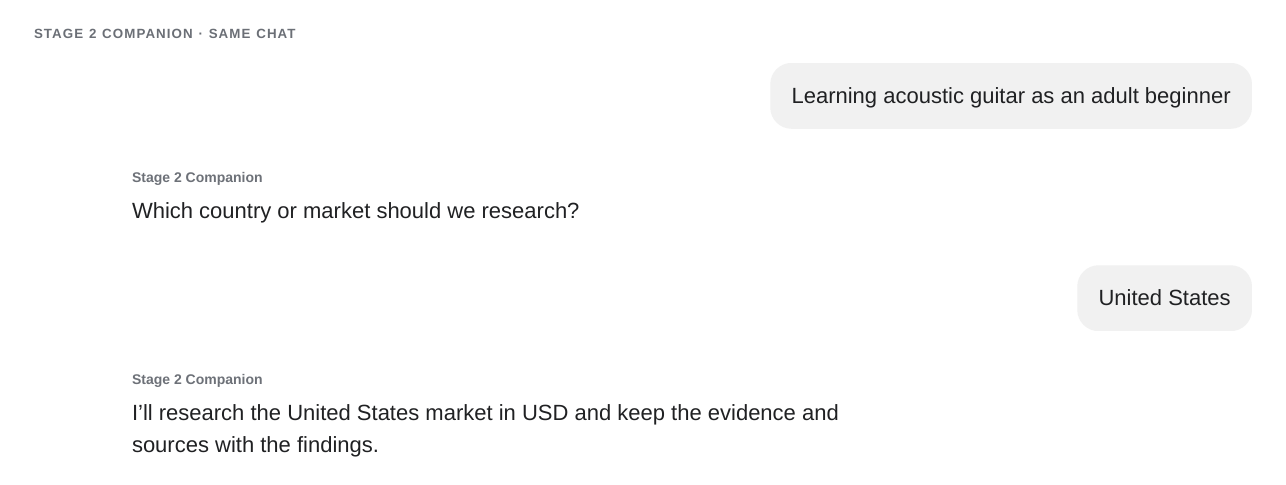
I opened the Stage 2 Companion and gave it the niche I’d brought out of Stage 1:
I used ChatGPT for this one, but the Companion isn’t tied to it. If your preferred AI can search the live web, it should work there too. If it gives you trouble, let me know through the Contact page.
Learning acoustic guitar as an adult beginner
That was it.
The Companion asked me one question:
Which country or market should we research?
United States.
Then it went looking.
When the report came back, I started scrolling.
Fender. Guitar Tricks. ArtistWorks. Thomann. Reverb. Used guitars. More accessories. More paid ways to learn.
And that was just the beginning.
There were prices. Memberships. Affiliate programs. Commission rates. Competition.
Sources for all of it.
Okay.
This was a lot more than my worksheet.
A lot more.
For a minute I wasn’t even sure where to start.
Near the top, the Companion gave me an escape hatch:
Scroll down if you want to see a summation of the report in plain English first.
Perfect.
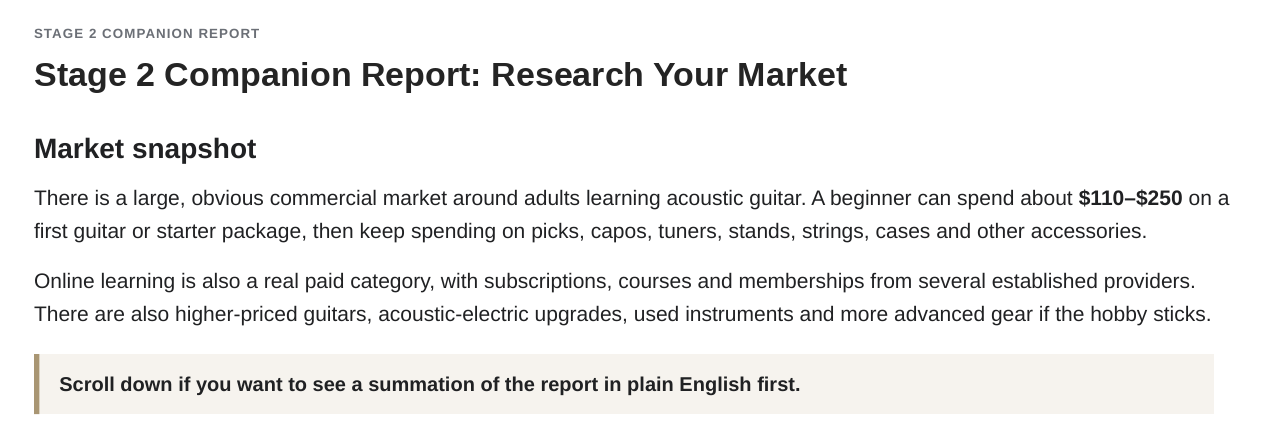
Download the full beginner-guitar market report (PDF)
This is the complete Companion report used for the worked example, including the detailed evidence and sources.
So I skipped past the detailed report for a minute.
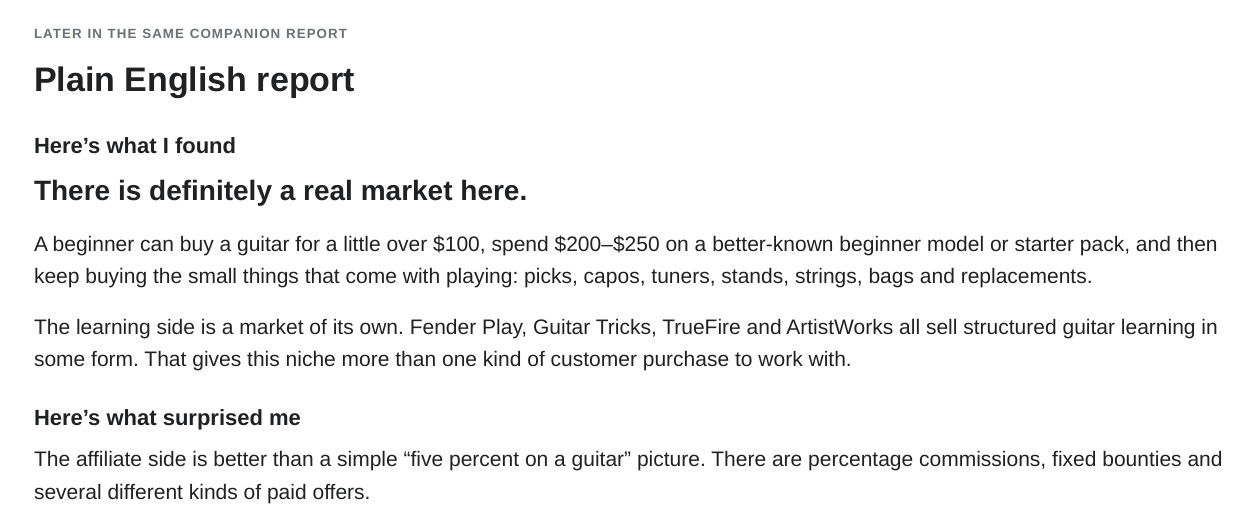
The first line was:
There is definitely a real market here.
Well, that answered one question.
Underneath it was basically the market I had been finding one tab at a time, only much bigger.
Guitars a little over $100. Starter packs around $200–$250. Accessories all over the place. Paid lessons. Memberships. Used gear. Better guitars later if the hobby stuck.
My worksheet had Gear4music and TrueFire.
The Companion had Fender, Guitar Tricks, ArtistWorks, Thomann and Reverb sitting there too, with prices and affiliate details underneath them.
Because I’d done the little pass myself, I knew what I was looking at.
I’d found enough to understand the report.
I just hadn’t found anything close to this much.
Okay.
That was what I wanted this thing for.
Then I got to the platform glimpse.
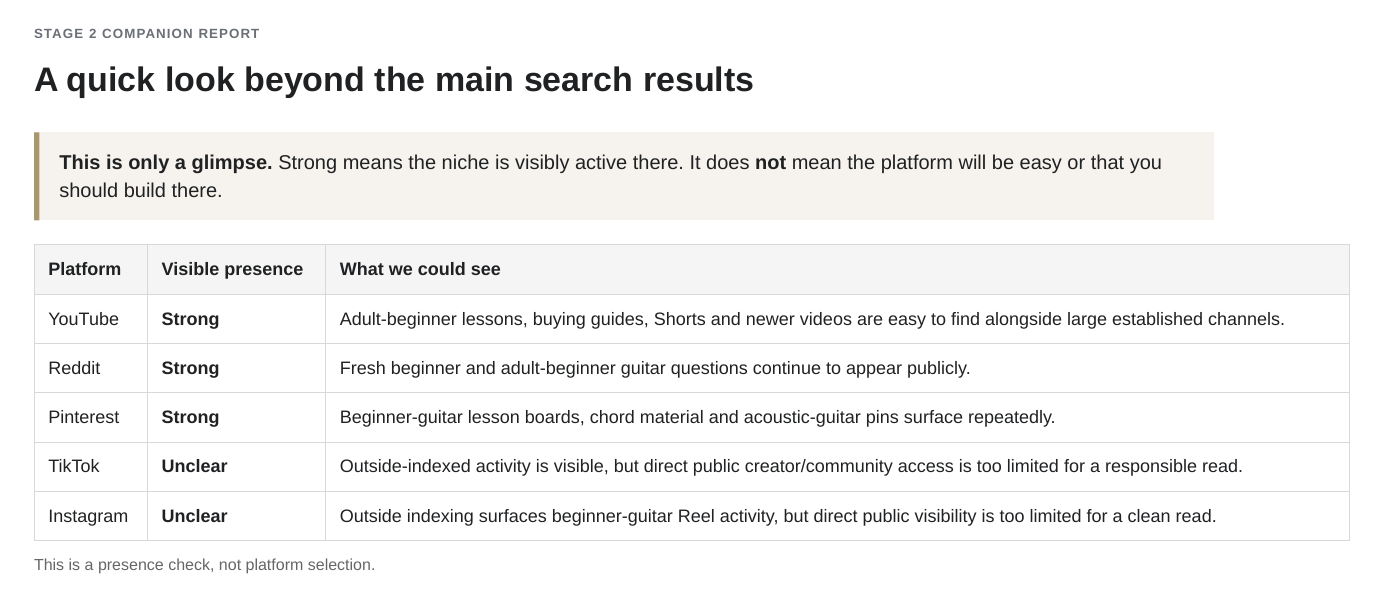
YouTube: Strong. Reddit: Strong. Pinterest: Strong. TikTok: Unclear. Instagram: Unclear.
I caught myself reading Strong as “good place to build.”
Nope.
Wrong question.
It only meant the niche was easy to see there from the public evidence the Companion could get at.
TikTok and Instagram came back Unclear because it couldn’t get a good enough public look at them.
If I cared about either one later, I could go look myself.
The obvious Google searches had looked crowded. At least now I knew Google wasn’t the whole internet.
Then I hit the score table.
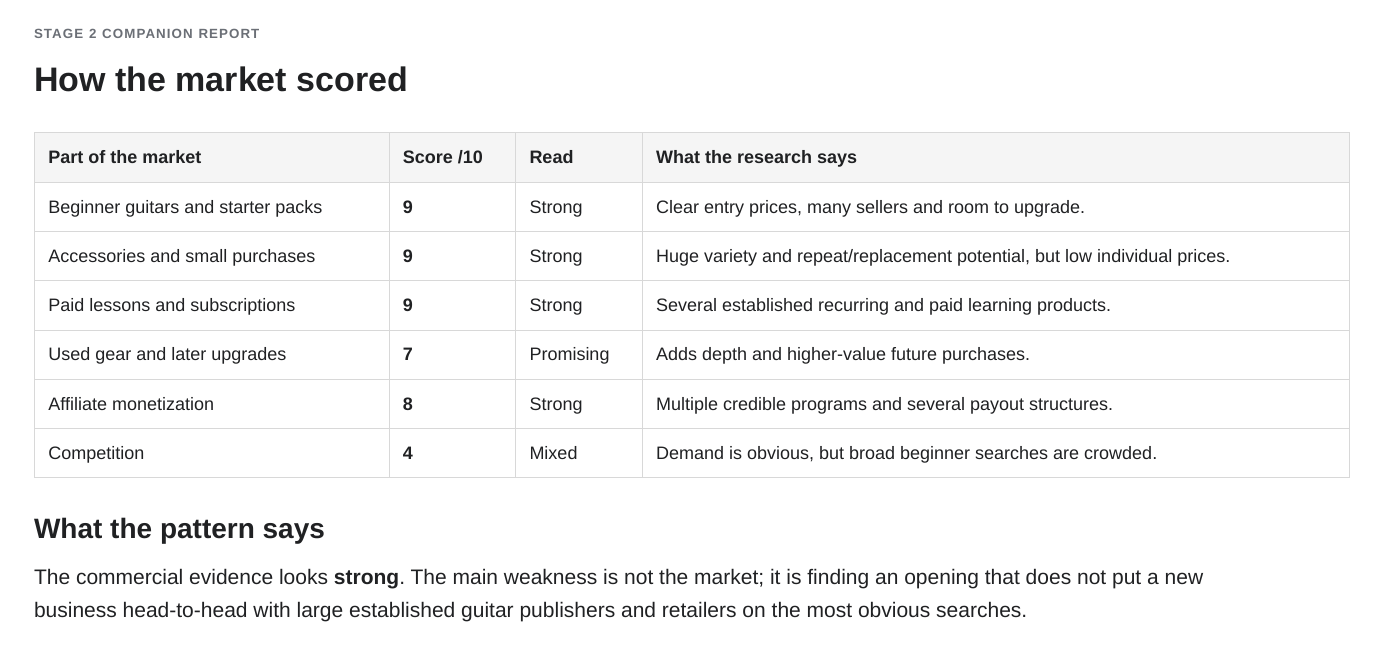
Beginner guitars and starter packs: 9. Accessories: 9. Paid lessons and subscriptions: 9. Used gear and later upgrades: 7. Affiliate monetization: 8. Competition: 4.
Yeah.
No surprise there. The obvious Google searches had looked crowded to me too.
At the bottom of the report, the Companion asked:
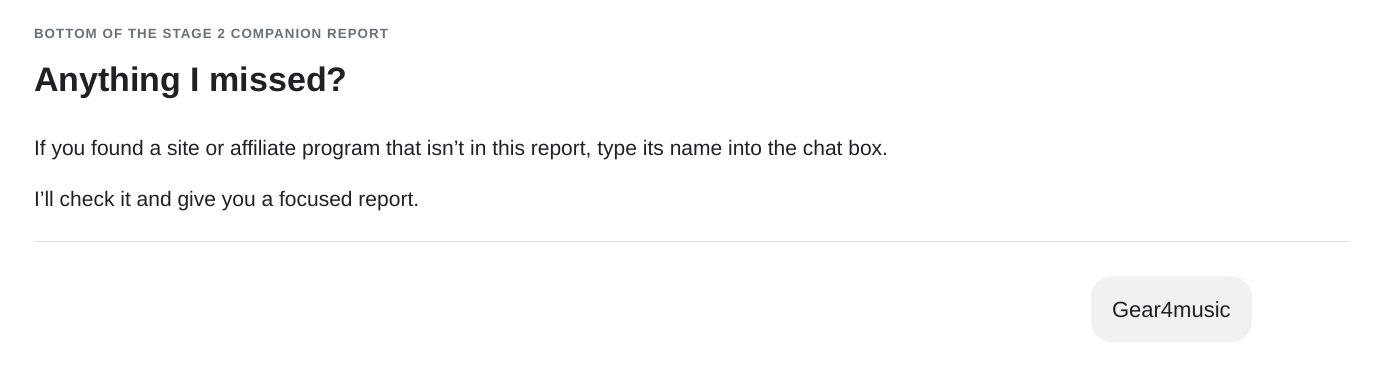
Anything I missed?
I had one.
Gear4music
So I typed it into the chat box.
When it came back, there it was.
U.S. store. Affiliate program through Awin. Up to 5% commission on sales. A 30-day tracking window.
Basically, the Gear4music stuff I cared about, checked and put in one place.
It also kept the little words up to attached to the five percent.
Good.
Five percent was possible. It wasn’t guaranteed.
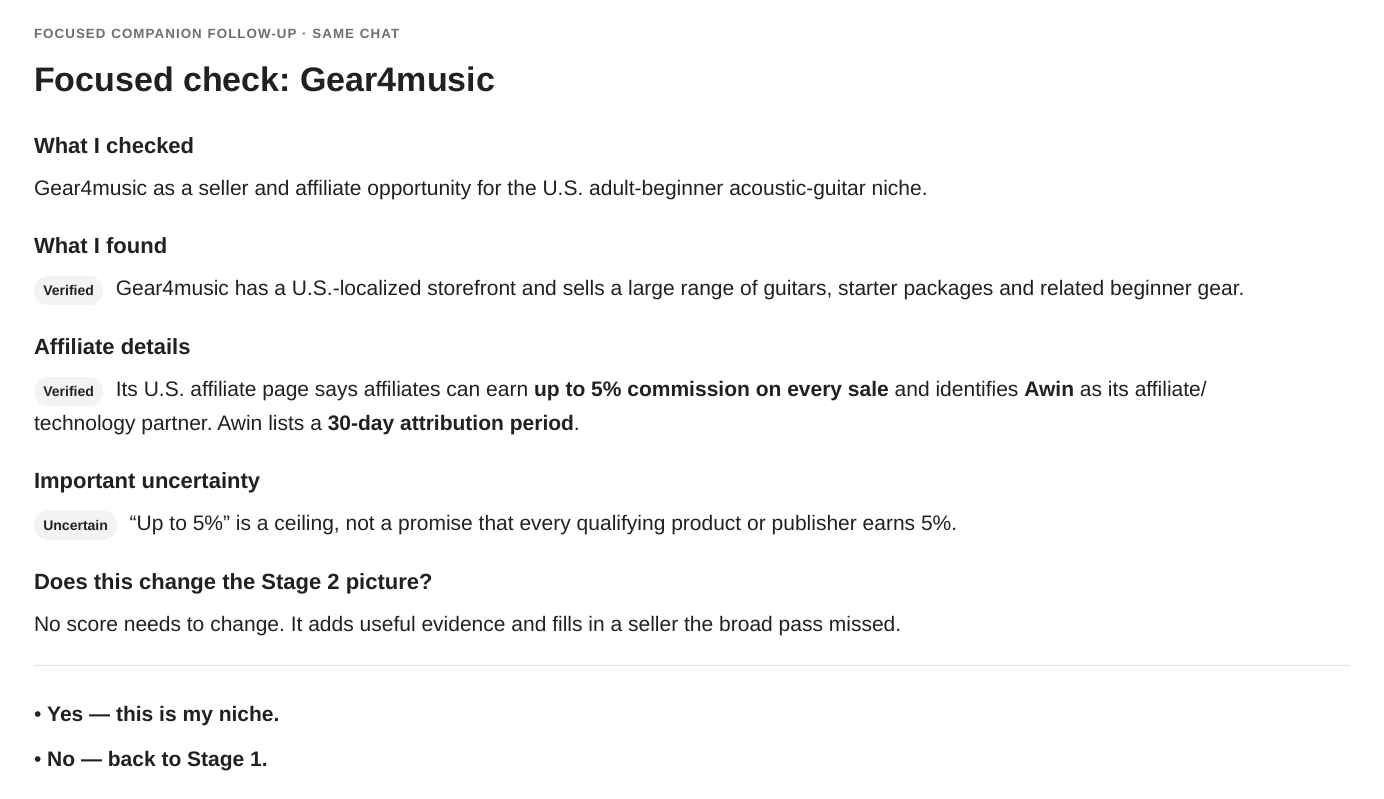
That was handy. I didn’t need another giant report. I just wanted Gear4music checked properly.
I’d found something the first pass missed, handed it back, and the Companion filled in the hole.
That was enough to make the decision.
So, is this my niche?
This was why I came into Stage 2 in the first place.
I didn’t need to know everything about the guitar market.
I needed enough to choose the niche or go back and find another one.
So, guitar. What have I learned?
People are buying things.
Plenty of them.
There are several believable ways I could get paid.
Competition is real, especially on Google, but it isn’t enough to send me running back to Stage 1.
And after all those guitars, courses, affiliate pages and capos, I’m still curious.
That’s enough for me.
Learning acoustic guitar as an adult beginner
Yes. That’s my niche.
Stage 2 done.
Your decision
Your turn.
Same choice.
Yes or no.
If it’s yes, save the Companion report.
Keep your worksheet too if you found something useful the Companion missed.
The provisional niche you brought out of Stage 1 isn’t provisional anymore.
That’s your niche.
If it’s no—or you’re still unsure—go back to Stage 1 and pick another one.
Annoying maybe, but a lot cheaper than building the wrong business for six months.
That’s it.
Close the seventeen tabs.
Next, we’re off to the races.