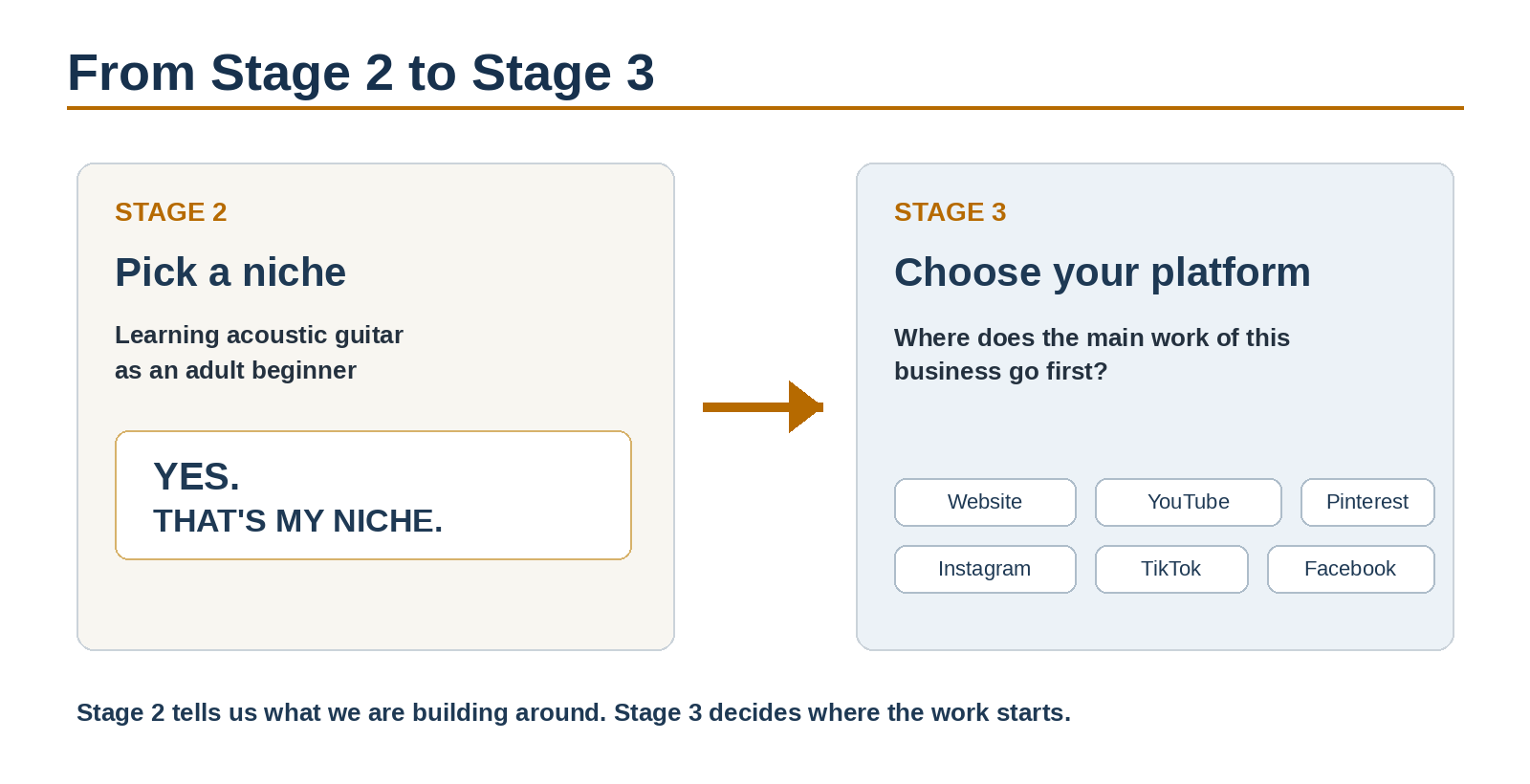
At the end of Stage 2, our guitar niche survived:
Learning acoustic guitar as an adult beginner
Great.
Now where are we going to build the thing?
A website?
YouTube?
Instagram? TikTok? Pinterest? Facebook?
Every one of them is technically an answer.
Trying all of them is also a pretty good way to spend the next month creating empty accounts and wondering why nothing is getting done.
We need one place to start.
The platform is not the business
A platform is simply where we are going to publish useful work and reach people.
A website can do that.
So can a YouTube channel.
Pinterest, TikTok, Instagram or a Facebook Page might do it too if the business gives us a good reason to be there.
But none of those things is the business.
They are not the niche.
They are not the product.
Choosing YouTube instead of a website does not turn our guitar business into some completely different animal.
The basic job is still the same: make something useful enough that people pay attention, earn some trust, and recommend a product or service when that recommendation actually helps.
We are deciding where that work starts.
Not where it has to live forever.
Stage 3 Platform Kit
The Stage 3 Platform Kit has the printable worksheet and the Stage 3 Companion.
If you downloaded it, keep the worksheet nearby.
If you didn’t, don’t disappear on me now. I’ll show the important pieces as we use them, so you can still do the whole tutorial.
Same guitar. Different person.
Before we start comparing platforms, we need to add something Stage 2 couldn’t really give us.
The person.
Take our adult-beginner guitar business and hand it to somebody who likes writing.
They enjoy digging into something, comparing two products and explaining what they found. Sitting down with a blank page doesn’t bother them.
Video does.
They don’t want to film themselves. They have no interest in learning video editing. If somebody told them the secret to affiliate marketing was uploading three videos a week, they might decide stamp collecting had real potential.
A website is starting to look pretty good.
Now hand the exact same guitar niche to somebody else.
This person likes explaining things out loud.
They are perfectly happy recording voice-over and filming their hands on a guitar, a tuner, a capo or a computer screen.
Writing a long article every week sounds awful.
YouTube just got a lot more interesting.
Nothing happened to the guitar market.
Same customers.
Same products.
Same commissions.
We changed the person doing the work.
And the sensible place to start moved with them.
So before we spend another minute arguing about platforms, we need to know something about you:
What kind of work can you actually see yourself doing?
What does the work look like?
Here is the first piece of the worksheet.
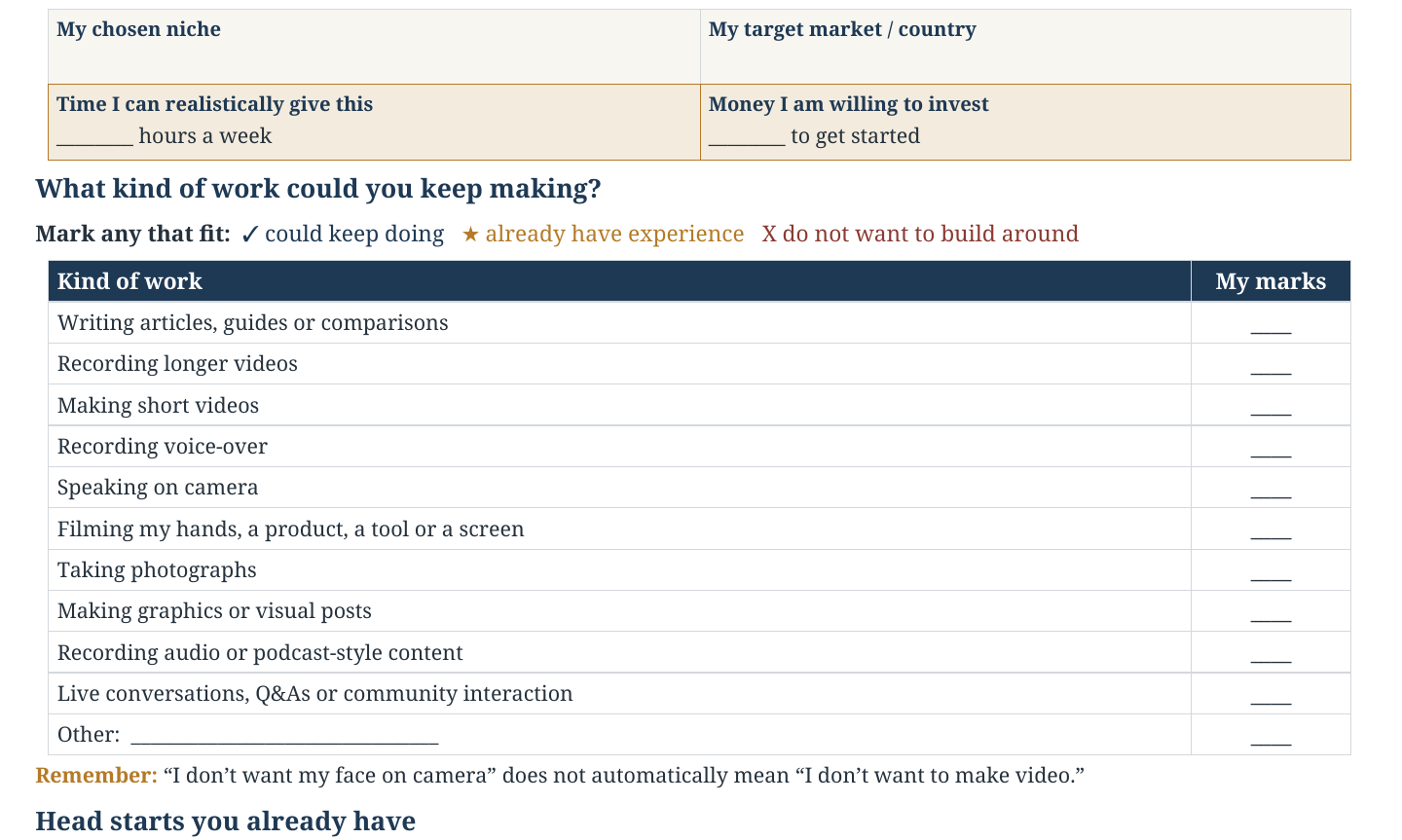
If you have the worksheet, use it.
If you don’t, use the picture and jot down a few notes somewhere.
It shows the kinds of work that feed these platforms: articles and guides, longer videos, short videos, voice-over, filming your hands or a product, photography, graphics, audio, live conversations and community work.
We are not choosing a platform yet.
Just look at the work.
For each one, there are basically three answers:
Yep. I could keep doing this.
I already have some experience with this.
No thanks. I do not want to build my business around this.
You can pick more than one.
Maybe you know how to edit short videos and never want to edit another one.
Experience?
Yep.
Want to spend the next year doing it?
Nope.
That is useful information.
Our guitar builder can write.
They haven’t done much serious video editing, but talking through a problem and recording voice-over sounds fine.
Filming their hands on the guitar sounds fine too.
Filming their face does not.
There is a difference.
I don’t want my face on camera does not mean I won’t make video.
A guitar lesson can show the guitar.
A capo review can show the capo.
A chord problem can show the hands making the chord.
Nobody has to stare lovingly into the camera while doing it.
Our guitar builder is starting to look like an actual person now.
We still don’t have a platform.
That’s okay. We aren’t done.
What are you bringing with you?
Starting a new business does not always mean starting from nothing.
Maybe you already have a small YouTube channel.
Maybe you have been posting guitar clips on Instagram for two years.
Maybe you own a website.
Maybe you write all day for work.
Maybe you already know how to edit video.
Maybe there is a perfectly good microphone sitting six inches from your computer right now.
Those things count.
An audience counts too, if it has something to do with the business.
Two thousand people following your guitar posts could be a pretty useful head start.
Two thousand people following pictures of your lunch probably won’t help much.
Unless lunch is your niche. Then I take it back.
The worksheet gives you a place to write down whatever might keep you from starting completely at zero.
Then we need two numbers:
I can give this about:
________________________ hours a week
I am willing to invest about:
________________________ to get started
Use the real numbers.
Four hours is four hours.
Zero dollars is zero dollars.
There is not much point building a twenty-hour-a-week plan for somebody who has four.
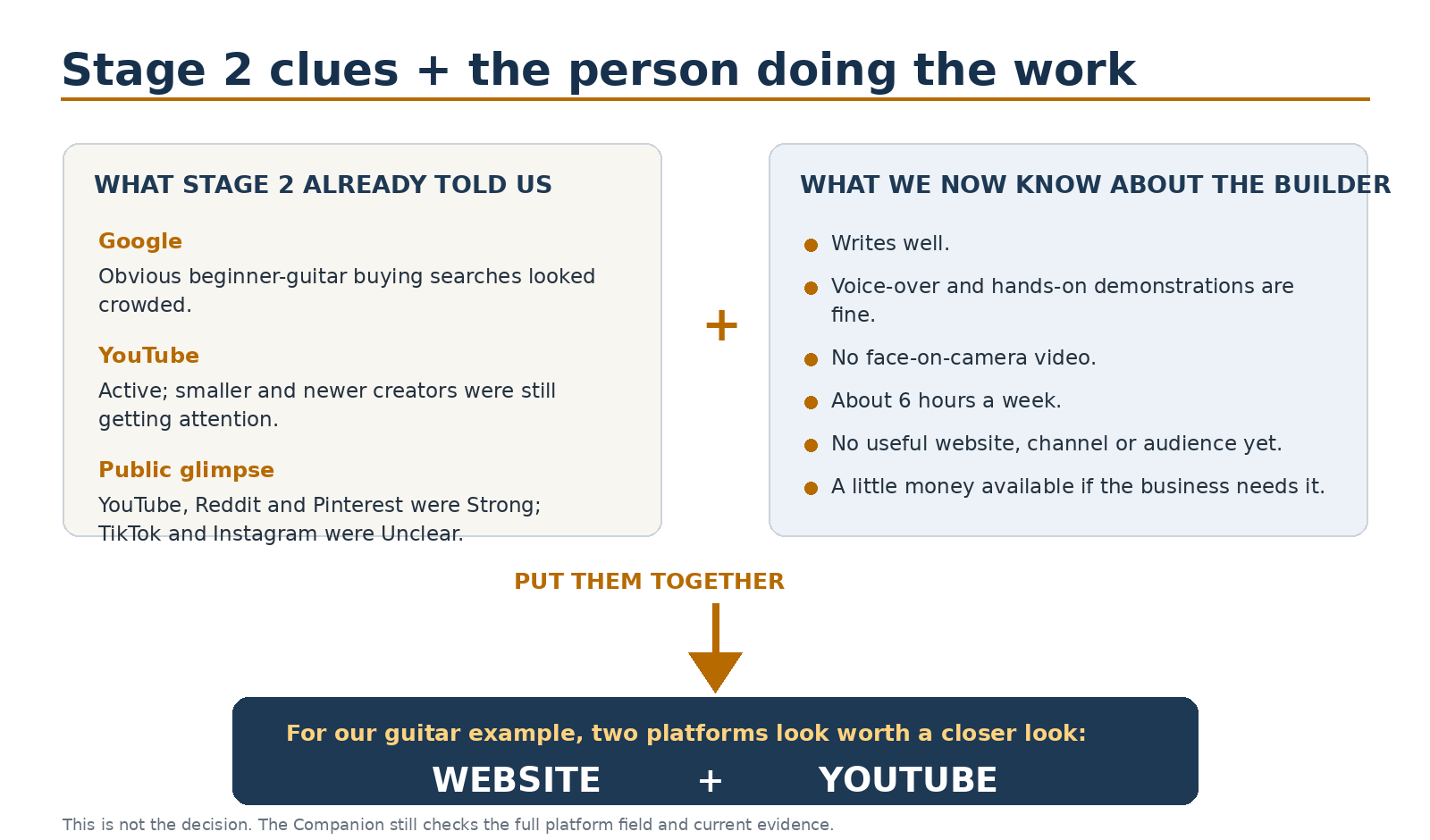
For the rest of our guitar example, let’s give our builder six hours a week.
They can write.
They are comfortable recording voice-over and filming their hands, the guitar, gear and a computer screen.
They do not want their face on camera.
They can invest a little money if the business actually needs it.
No useful website.
No useful channel.
No audience waiting for them somewhere.
Okay.
Now we have somebody to build for.
Bring Stage 2 back onto the table
We already did a bunch of research. We might as well use it.
Our Google searches showed us that the obvious beginner-guitar buying searches were crowded.
When we looked at YouTube, there were plenty of big channels, but smaller and newer creators were getting attention too.
Then the Stage 2 Companion took a wider look and came back with:
YouTube — Strong
Reddit — Strong
Pinterest — Strong
TikTok — Unclear
Instagram — Unclear
None of that chose our platform.
It gave us clues.
Now those clues have a person attached to them.
Our guitar builder can write, so a website stays alive.
They are fine with voice-over, demonstrations and filming their hands, so YouTube stays alive too.
They have six hours a week and no existing audience anywhere.
That makes me considerably less excited about handing them four different platforms that all expect to be fed.
Pinterest may eventually have a job.
Reddit may be useful for seeing what beginner guitar players are asking, complaining about or getting stuck on.
Fine.
Neither one has to become another job today.
For this builder, the giant platform question has shrunk to:
Website
or
YouTube
Much better.
Now do yours
Before you fill yours in, here is Page 1 for our guitar builder.
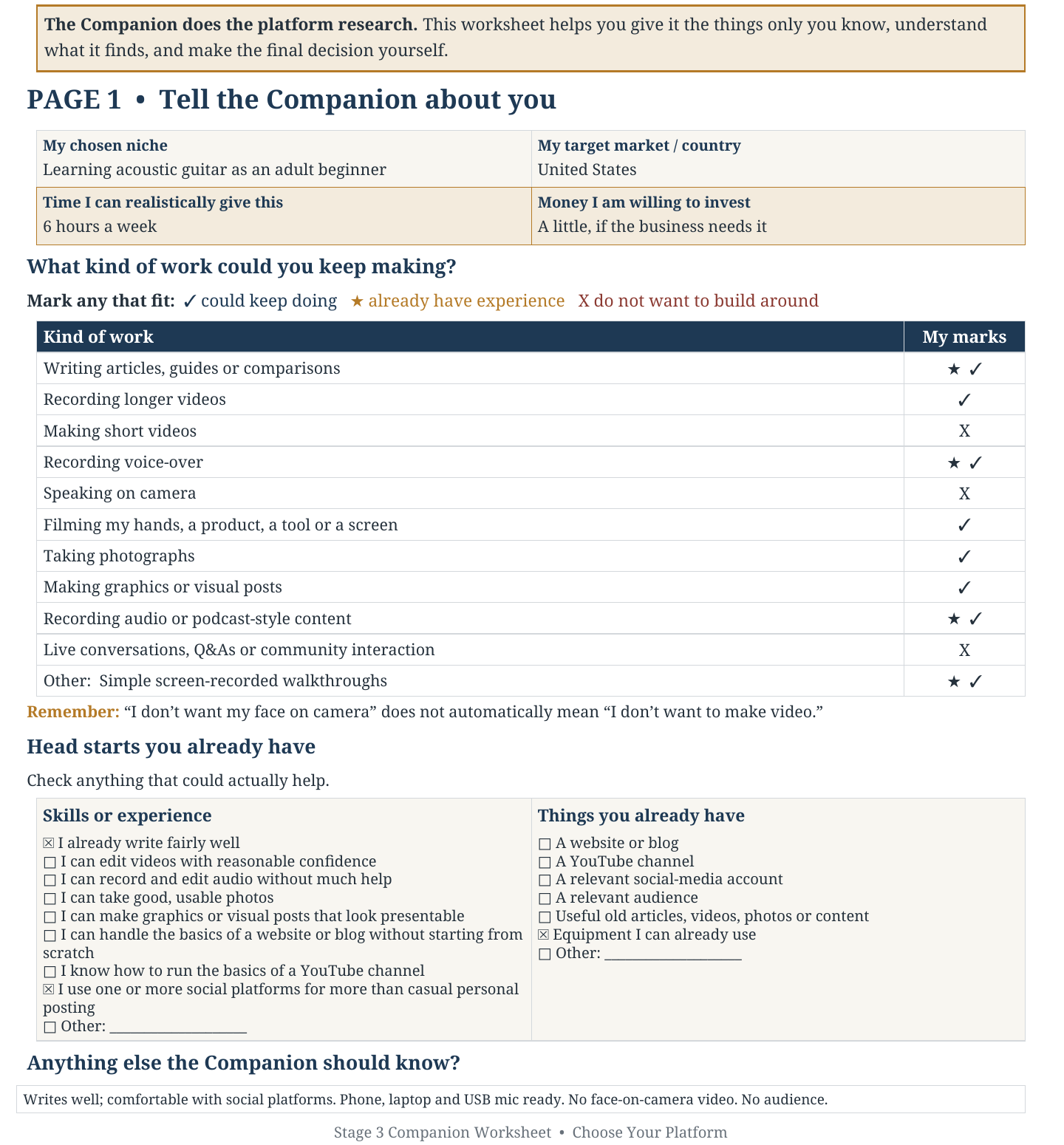
That is our example. Do not copy it. Yours should describe the person who will actually be building your business.
Now fill in Page 1 of your own worksheet.
Put your niche and market at the top. Then mark the kinds of work you could keep doing, anything you already have some experience with, and anything you really do not want to build around.
Add any useful head start you already have, then give it the real numbers: how much time you can give this each week and how much you are willing to invest if the business needs it.
Do not try to choose your platforms on this page. That is the Companion’s job.
You are giving it the part it cannot look up: you.
Keep the worksheet beside you. The Companion is going to ask for these answers in a minute.
So what are we actually choosing?
This is the part I don’t want to leave fuzzy.
We are not choosing which platform we think is coolest.
We are not choosing the platform we promise to use for the rest of our lives.
We are deciding where the main work of this business goes first.
Our guitar builder has about six hours a week.
If Website wins, a big chunk of those six hours is going into writing, publishing and learning how to run the site.
If YouTube wins, those same six hours start going into planning videos, recording them, editing them and learning how the channel works.
That is the choice.
Which place gets first claim on our time, work and attention while we try to get this business moving?
We can add things later.
Right now, one of them gets to go first.
Make sure the plan can actually work
Before we pick one, there is one more thing I want to know.
Say our guitar builder makes a video about beginner capos.
They show the capo they use, explain why they like it and recommend it.
Somebody watching thinks:
That looks useful.
Now what?
They need a way to get from the video to the capo.
That is usually where an affiliate link comes in.
It is a special link supplied by the affiliate program. If somebody follows that link and makes a qualifying purchase, the company can tell who sent them and pay the commission.
We are not setting up affiliate links today.
I just don’t want us choosing a platform and finding out later that the little money-making path we had in our heads doesn’t actually work there.
So we need a few current answers.
Can people get from our content to the things we recommend?
Can we put an affiliate link where we think we can put one?
Will some of the real affiliate programs in our niche work with the platform we are considering?
And do any of those programs expect us to have something built before they will let us in?
That last one can look worse than it is.
Suppose an affiliate program accepts YouTube channels but wants to see some real content before approving one.
We have an empty channel.
They say no.
That does not necessarily mean:
YouTube was the wrong choice.
It may simply mean:
Come back when there is something here.
Build first.
Apply later.
Different problem.
A small rule can change the plan
YouTube gives us a nice example.
In a normal long-form YouTube video, outside links in the description can be clickable once the channel has access to what YouTube calls advanced features.
The name makes it sound more mysterious than it is.
It is an account-access level.
It is not:
Get 10,000 followers and YouTube finally lets you have links.
YouTube can grant the access through enough channel history, or may let the creator unlock it sooner through ID or video verification.
But YouTube Shorts are different.
A normal web address typed into a Short’s description or comments is not clickable.
So imagine our entire plan was:
Make Shorts → put guitar affiliate link underneath → viewer clicks link
Oops.
There is a hole in the plan.
That doesn’t mean Shorts are useless.
It doesn’t even mean YouTube is wrong.
It means we found out how the thing actually works before building around something it doesn’t do.
Good time to find that out.
The affiliate program gets a vote too
Then there is the company on the other end of the link.
They get a say.
TrueFire was one of the real guitar programs we found in Stage 2.
Its current affiliate page says somebody with a music-focused website, blog or social-media channel can apply.
So TrueFire does not force our builder into a website.
It does not force them onto YouTube.
Either one can fit that program.
Another affiliate program may have different rules.
We do not need to investigate every guitar company on Earth before choosing a platform. We just need enough real evidence to know we are not building toward a dead end.
This is exactly the sort of page-chasing the Companion is useful for.
Let the Companion do the digging
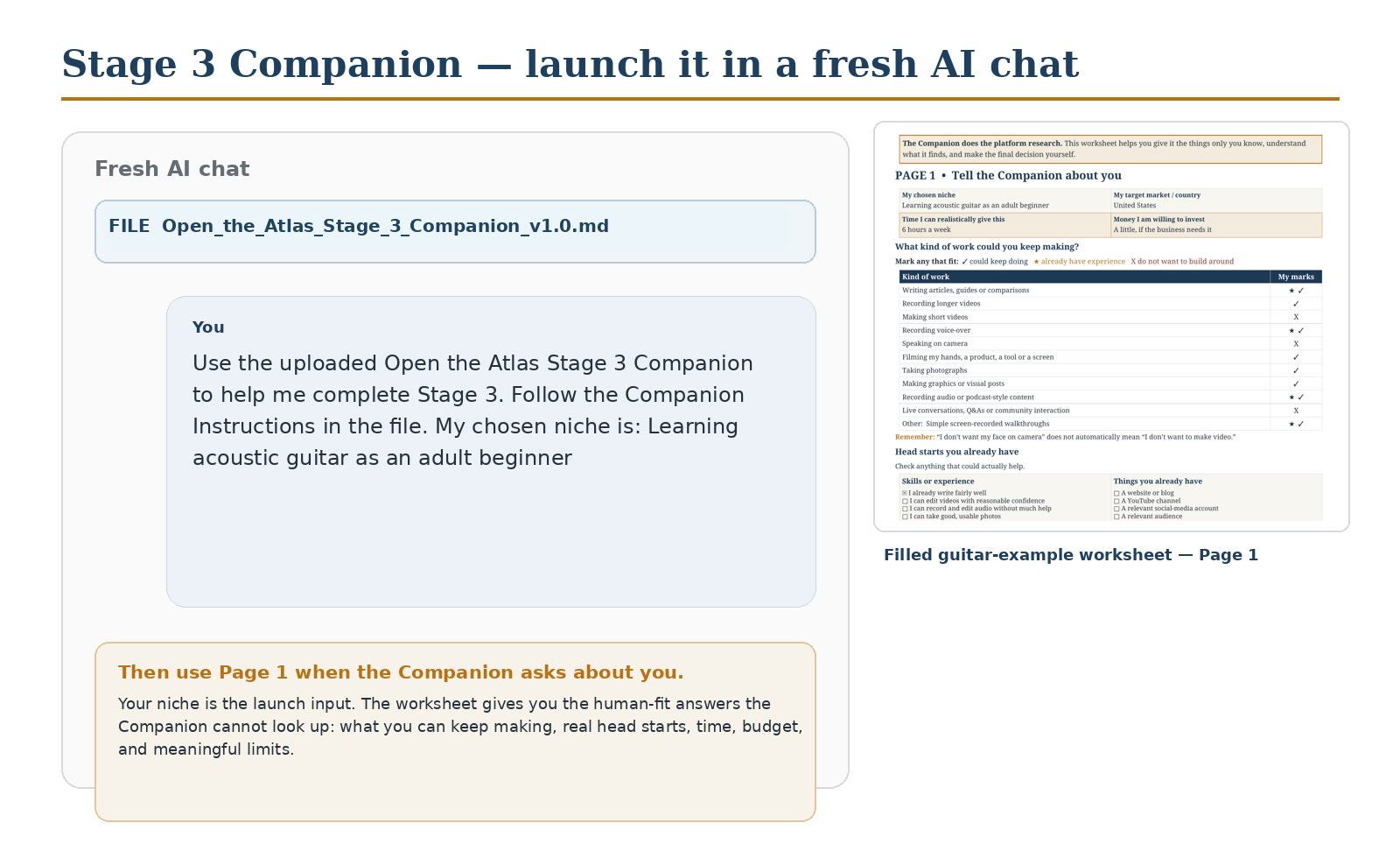
Open the Stage 3 Companion in a fresh AI chat.
You do not need to drag your Stage 2 report in with you.
You do not need your old conversation.
You need the niche you chose.
Upload the Companion and say:
Use the uploaded Open the Atlas Stage 3 Companion to help me complete Stage 3. Follow the Companion Instructions in the file. My chosen niche is: [YOUR NICHE]
For our guitar example:
Use the uploaded Open the Atlas Stage 3 Companion to help me complete Stage 3. Follow the Companion Instructions in the file. My chosen niche is: Learning acoustic guitar as an adult beginner
It will ask which country or market you are building for.
Then it needs to know something Stage 2 did not know:
you.
Most of those answers are sitting on the worksheet now.
What kind of work can you keep making?
What do you already know how to do?
What do you absolutely not want to build around?
Do you have an audience, account, skill or piece of equipment that gives you a useful head start?
How much time do you really have?
How much are you willing to invest?
And be specific.
I don’t want my face on camera is not the same answer as I won’t make video.
We already found that out.
Then let the Companion do the digging.
When it comes back
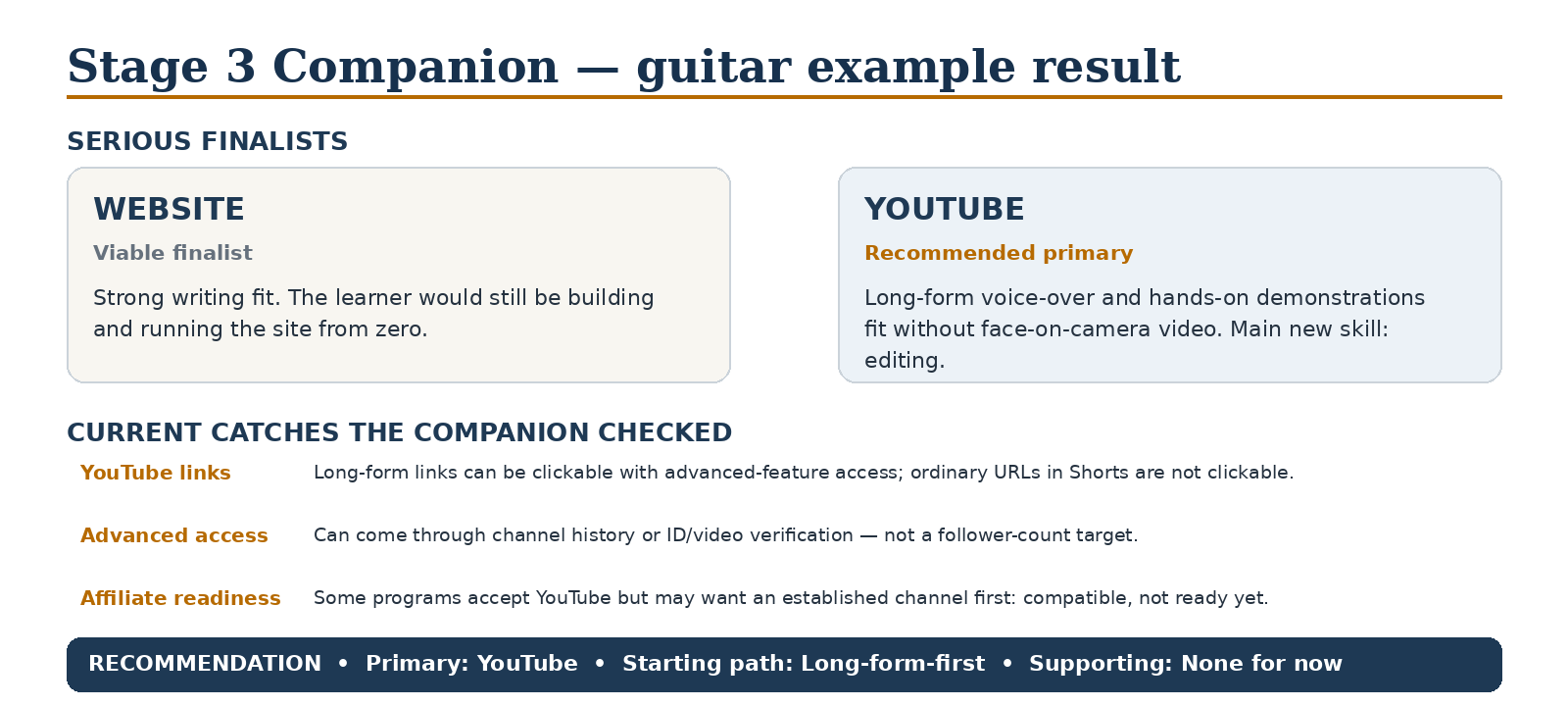
The Companion can recommend a primary platform.
It can also recommend a supporting platform if it finds a real reason for one.
The numbers and scores help, but they are not the decision.
What I really want to know is:
What does choosing this platform mean I am going to spend my time doing?
Go back to our two guitar finalists.
Website
Our builder can write.
Articles, comparisons and detailed guides fit.
A website gives them room to teach something properly, compare products and make recommendations where they belong.
They have never built or run a website.
So if Website wins, part of those six hours is going into learning that.
Writing.
Publishing.
Getting comfortable with the site.
That is what choosing Website means for this person.
YouTube
Our builder likes explaining things out loud.
They are comfortable filming their hands, the guitar and the gear.
A chord change, a capo, two beginner guitars or a practice problem can all be shown instead of described.
Their face never has to appear.
They haven’t made much serious video.
So if YouTube wins, part of those six hours is going into learning to record and edit useful video.
That is what choosing YouTube means.
There is no magic platform hiding behind door number three.
We are deciding which kind of work gets the first six hours.
For this version of our guitar builder, YouTube has a pretty strong case:
Primary platform: YouTube
Starting lane: Long-form video
The work fits the person.
Stage 2 gave us a reason to look there.
The current affiliate path works.
And nothing we found gives us a good reason to throw it out.
Could Website work?
Sure.
Give the same guitar business to our first person—the one who would rather write three articles than edit one video—and I’d probably be looking pretty hard at Website.
Same niche.
Different person.
Different choice.
What about a supporting platform?
This one is worth slowing down for because supporting platform can easily become code for:
And now I have to do Instagram too.
No.
Your primary platform is where the main work of the business starts.
A supporting platform has a smaller, different job that helps it.
Suppose Website wins.
Our builder writes a useful article about beginner chord changes.
Later, Pinterest turns out to be a good place to put a simple chord graphic that points people toward that full article.
Those jobs make sense together.
Website: the article lives here.
Pinterest: helps somebody find it.
Pinterest is supporting the website.
Now suppose YouTube wins and our plan is:
I’ll make YouTube videos.
Then somebody says:
Great. Also make a completely separate stream of Instagram content and build another audience there.
That may turn into a good idea someday.
Today it sounds a lot like we just gave ourselves two jobs.
A supporting platform might help people discover the primary one.
It might reuse a piece of work we already made.
It might make use of an audience we already have somewhere else.
It might do one job the primary platform does badly.
But it needs an actual reason to exist.
The worksheet gives you one line for the supporting platform’s separate job.
Use it.
If you cannot give that second platform a genuinely different job, I’d be suspicious.
There is one more check I like:
Am I reusing work, or did I just invent another pile of work?
One website article turned into a few Pinterest graphics?
Okay.
Part of a YouTube video turned into a short clip for an account you already use?
Could make sense.
A brand-new website that now needs its own articles, SEO work and maintenance so it can “support” your brand-new YouTube channel?
That doesn’t sound much like support anymore.
That sounds like Tuesday and Wednesday just disappeared.
There is absolutely nothing wrong with:
Supporting platform: None for now
You can add one later when it has a real job.
For our guitar builder, that is where I would leave it.
YouTube already has plenty for us to learn.
Let’s learn it.
Make the call
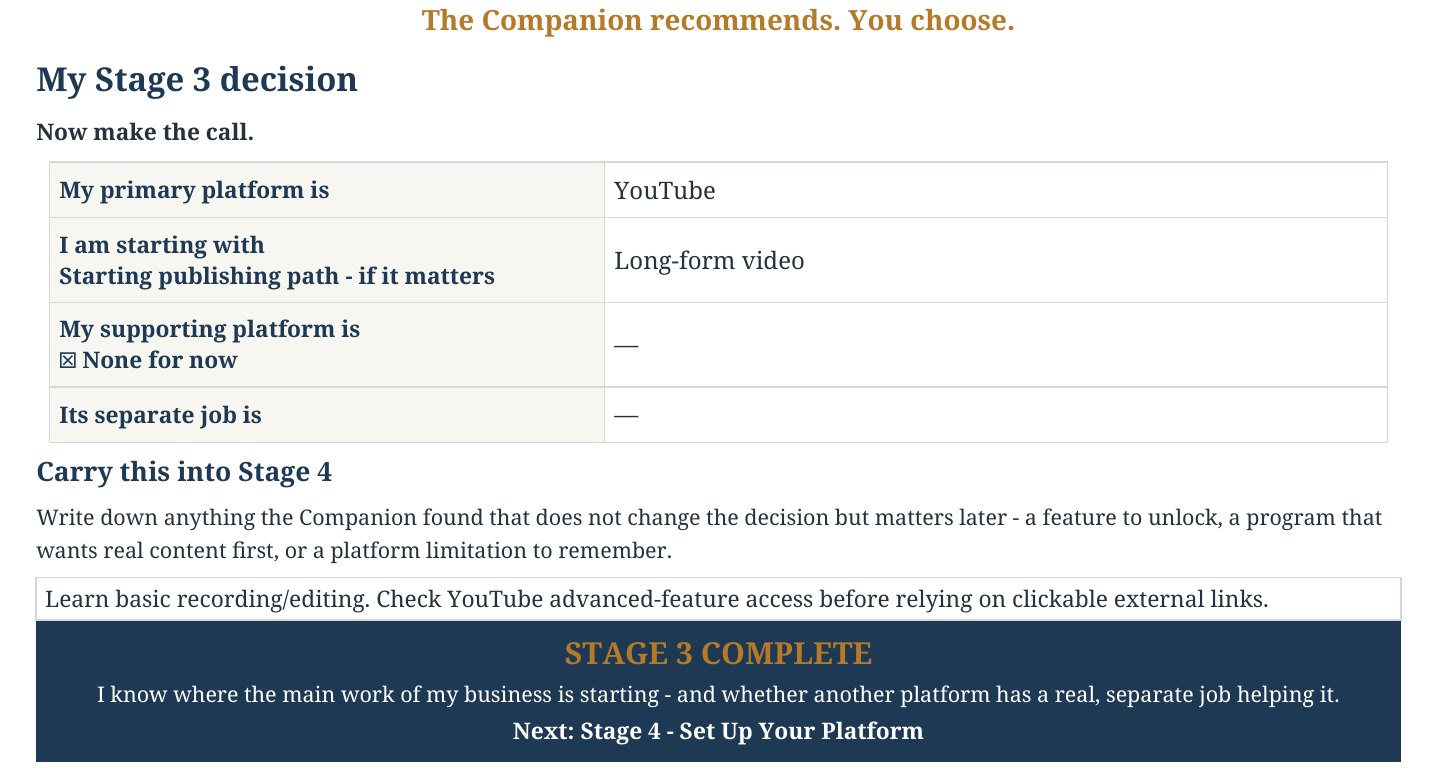
Go back to the last part of the worksheet.
My primary platform is:
For our guitar builder:
YouTube
If there is a useful starting lane inside that platform:
I am starting with:
For us:
Long-form video
Then:
My supporting platform is:
Its job is:
If the answer is:
None for now
write that.
That is enough.
We know where the work is going, and we have not accidentally hired ourselves to run six empty social-media accounts.
That’s Stage 3.
We know where we’re building first.
Stage 4 is where we set it up.
That is when the channel, website, profile, equipment and whatever else our choice really needs finally become our problem.
One problem at a time.
Next: Stage 4 — Set Up Your Platform